
KEF XIO Soundbar
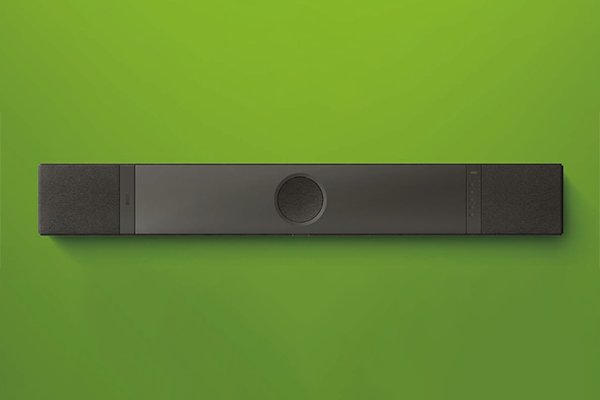
The soundbar market is filled with solutions, but what’s out there for integrators Mat Daley explores Kef’s foray into this space.
Another day, another soundbar promising incredible volume, bass and immersion. Is this the one? Maybe, maybe not, let’s dive into the new premium 5.1.2 Dolby Atmos soundbar from KEF, the KEF XIO.
ADVERTISEMENT
I’ll say this from the outset for context: I haven’t critically listened to a lot of KEF speakers and haven’t had much to do with them from a sales standpoint, so I come to this review with minimal preconceived notions of KEF and the “KEF Sound”. Apart from knowing that it’s highly regarded in HiFi circles and that KEF’s engineering pedigree spans from compact bookshelves to six-figure statement speakers like the Muon.
The KEF XIO Soundbar is their newest addition and aims to deliver KEF-grade audiophile performance from a sleek, small form factor. When a company with that level of engineering capability applies its thinking to an everyday product like a soundbar, it’s worth paying attention.
The XIO is the newest addition to KEF’s lineup and aims to deliver audiophile-grade performance from a sleek, compact form factor. While it is obviously not attempting to rival KEF’s flagship loudspeakers, the XIO firmly occupies the upper tier of the soundbar market. This is not a mass-market TV add-on; it is clearly targeted at audiophiles, design-focused residential installations and KEF loyalists.
With an Australian RRP of $3,600, the XIO competes directly with products such as the Devialet Dione and Sennheiser Ambeo Max (at least in terms of price and ambition).
The XIO is a beautiful piece of equipment for sure. The Silver Grey variant that was sent to me to test looks and feels every bit the luxury item its price suggests. Quality materials with an understated but solid look and feel were my first impressions. It’s also available in a Slate Black colour, which I imagine looks and feels equally well considered, but I can certainly say that the Silver Grey model hits the mark, exuding high-end HiFi style and is on brand for KEF. It would absolutely look at home in a luxury residential setting.
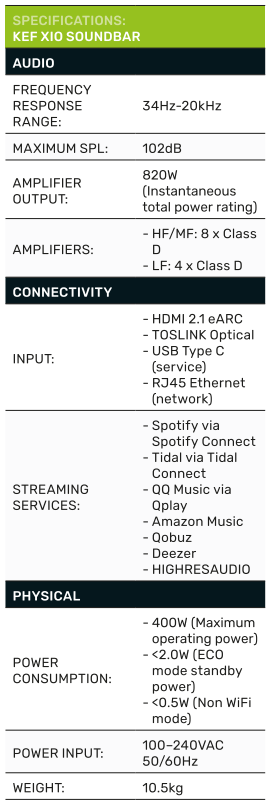
The physical setup was straightforward for my simple little test scenario using HDMI eARC direct from my TV to the soundbar and utilising CEC for simple on/off and volume control from the TV remote. The XIO can also pair wirelessly with KEF’s active subwoofers by adding their KW2 wireless receiver to their KC62, KC92 and Kube subs. For those with an existing third-party subwoofer or specific subwoofer preference, the RCA sub out is an excellent inclusion.
In addition to these inputs and outputs, you also have a LAN port and optical audio in. There is also mention on KEF’s website of future support for wireless surround speaker functionality, but at the time of testing, this was not available
The remainder of the setup and “calibration” is handled by the KEF Connect app, which allows you to add your music streaming services, calibrate and create audio presets. Most of your typical streaming services are available, as well as access to your own networked library, with support for up to 384kHz/24-bit resolution playback. Apple Music is noticeably absent, but it does have AirPlay 2 support.
To set up a profile, the app steps you through the calibration process with its EQ Wizard. The first few steps of the wizard ask basic questions about your space to determine how high the soundbar is from the floor, how big your space is and if you are using a subwoofer, wired or wireless. This stage is essentially a base calibration to listen and adjust for your room and installation type, as the soundbar can be oriented for a benchtop or wall mount.
The next step was intriguing to me. At the point where you hit calibrate on the app, the soundbar plays a very brief calibration tone. This tone is what I would describe as an ocean-type sound that lasts about ten seconds while your phone’s microphone listens and determines the effects of the room on the original sound. Nothing new, but it was just so quiet, so short, and only required a single static reading. No traditional tone sweeps, no taking readings from multiple points.
The thing that really surprised me is that the tone didn’t seem to contain any audible bass. Nonetheless, I’m sure the engineers at KEF know far more about room acoustic and audio calibration than me, so moving on.
Once you have your initial calibration done, you can start to make some of your own personal audio profiles based on some EQ presets. There are two modes to set up a profile: Normal and Expert mode. Normal mode is limited and simply asks for your room details, if you have a subwoofer connected, and you simply get to select one of the preset EQ profiles. Using the Expert mode, though, gives you access to some deeper parameters that any self-respecting integrator or audiophile would want access to. These are still pretty limited, but they do give you a greater level of customisation.
First is a basic ±3dB treble adjustment called Treble Trim with no real info on what frequencies are affected or how they are adjusted, but it is essentially a high-end boost or cut. Next is Bass Extension with a simple, less/standard/extra preset to choose from. Again, no actual information on the difference between these modes, but it seems to be just boosting the low end of the soundbar itself, not taking into account any extra extension or output from an external subwoofer.
From there, you get to the external subwoofer setup. For KEF sub owners, you have a drop-down menu of all their compatible subs, which cleverly guides you through the appropriate gain level and settings on the relevant subwoofer. If you are using a third-party subwoofer via the RCA sub output, you can select ‘other’ and adjust the high-pass frequency, sub out low-pass frequency and sub gain.
I was lucky enough to have this test unit for an extended period of time over the Christmas holidays, and my impressions evolved over time. Initially, I was a little underwhelmed, but I came to appreciate its sonic authenticity.
For its price, I wanted it to completely knock me off the couch and leave me wondering how they defied the laws of physics with the performance of this tiny package. Of course, that is an unrealistic expectation and marketing hype should never be believed. That’s not a dig at KEF specifically, more so a gripe with audio product marketing in general. I feel like you can read the description of a $100 Bluetooth speaker next to a professional high-performance product, and they both use all the same descriptors, but hey, they have to sell units, I get it.
To give an idea of how it sounds and performs, I feel the need to break it into two categories: music playback and movie playback.
Music playback
This is where KEF’s pedigree is evident. Listening to one of my go-to test tracks for clarity and nuance: Birds by Dominique Fils-Aimé, the XIO is engaging, delicate and delivers a detailed soundstage which feels impressively wide beyond the unit’s physical size.
Billy Eilish’s bury a friend quickly highlighted the limits of its low end, though. KEF states a frequency range of 34Hz-20kHz, which is a reasonable low end extension, but bass-heavy content will have you wanting for a subwoofer still.
Above all else, it sounds natural and hi-fi-esque, which is what was mentioned previously when I referred to it being sonically authentic. It’s not super bassy or overly coloured to make it feel exciting. It stays true to the content and delivers an authentic two-channel experience. One of the main reasons for this is the XIO’s array of six UNI-Q MX drivers, an adaptation of KEF’s UNI-Q point source drivers used in their higher-end products.
Movie payback
To deliver Dolby Atmos or any immersive audio content, the XIO has a true 5.1.2 channel count, meaning it isn’t virtualising or downmixing these channels; there are actual speakers dedicated to their output. This gives the unit a good sense of space and envelopment that doesn’t come with many soundbars.
While it’s a drastic improvement on the TV’s sound to be sure, the XIO didn’t shine for movie playback as it did with music. Dialogue was often buried at low volumes, but this seemed to correct in relation to the other channels as the volume was raised.
The XIO feels fun and immersive with plenty of output to fill a small room, but it never seems to do so with any definition and coherence. It more so washes the room with diffuse sound without you being able to localise a sound or perceive the movement of a sound object.
I’m specifically referring to surround and height channels here; the front left-right sound stage is as impressively wide and detailed as it is in music mode. I played quite a bit with all the different EQ modes, which surprisingly made very little audible difference. Immersive audio playback is inherently more complex than two-channel playback, and the XIO just didn’t quite hit the mark for movies as it did for music. Perhaps with the addition of the future wireless surrounds and subwoofer, its immersive audio playback will equal its two-channel prowess.
The truth is, none of these points are exclusive to the XIO and are just the reality of trying to recreate an entire room’s soundstage from a 1,200mm wide bar’s worth of speakers. Sometimes a soundbar is all you need, and you can physically fit or afford.
For the scenario where space or budget doesn’t allow a full system with separate speakers, a soundbar might be the best choice, and if you or your client wants a better version than most of this particular form factor, the KEF XIO is a compelling option. For a music-first buyer, the KEF is one of the best soundbars I’ve heard.
Manufacturer: KEF
Distributed by: Advance Audio Australia
-
ADVERTISEMENT
-
ADVERTISEMENT
-
ADVERTISEMENT
-
ADVERTISEMENT