
Christie 4K860-iS Projector
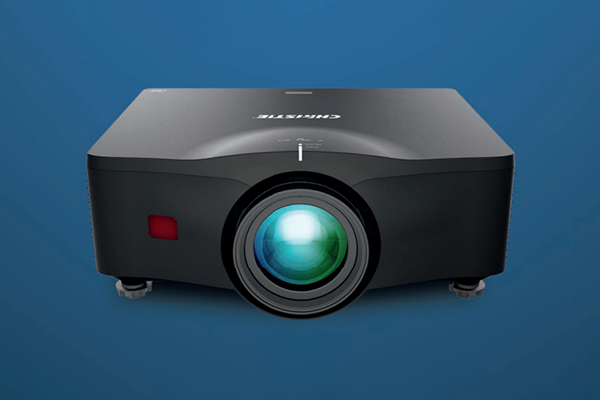
Christie has launched a projector that’s ideal for the AV integrator market. Stephen Dawson checks it out to see how it stacks up against the rest of the solutions out there.
Christie is an imaging company that mostly deals with big stuff. It makes projectors with tens of thousands of lumens of output for cinemas, video walls with many displays and video processors to feed those walls.
ADVERTISEMENT
Here, with the Christie 4K860iS projector, part of its Inspire range, things are somewhat smaller. But still quite big in the scheme of things.
What it is
This projector is a 4K – actually, UltraHD, which is 3840 by 2160 pixels – unit, with very high output: up to 8,500 ISO lumens or 7,200 ANSI lumens. Measurement methodology matters, so one should compare like with like. But it packages all this into a unit about the size and weight of a moderately high-end home theatre projector.
I measured it at 480mm wide by 205mm tall and 430mm deep, which was quite a bit different from Christie’s published specs. The weight is close enough to the claimed 15kg.
To achieve UltraHD output, it uses a Texas Instruments 0.65” DLP650TE digital micromirror device. I’ll go into that a bit more below.
For light production, the Christie 4K860-iS projector uses a laser-phosphor light engine. Specifically, it uses a blue laser to excite phosphor, which produces white light.
The light output is run through optics with a 1.25:2.00 zoom range. Christie suggests that it’s suitable for a 60-200” diagonal. As we’ll see, there’s plenty of brightness for that commonly claimed (but often not properly achieved) larger size. Unusually for Christie, given its professional orientation, this projector has a fixed lens (that doesn’t mean it won’t zoom. It means it can’t be swapped out for a different lens). The roughly 1.6:1 zoom ratio is quite wide. For a 100” display, the projector needs to be placed between 3.16 and 4.98m from the screen.
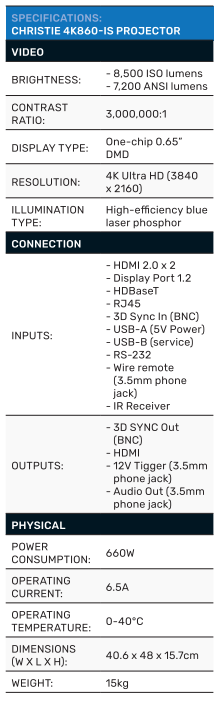
A decent amount of lens-shift – which permits the picture to be moved left and right, up and down, with respect to the projector without loss of resolution or significant distortion – provides a lot of flexibility for the projector. Christie specifies up to +/-110% vertically, and +/-50% horizontally. Those limits would typically be reduced where both horizontal and vertical shifting are being applied.
The projector has a couple of 10W speakers built in, which Christie sensibly markets as making “it easier to do audio setup and testing”. Obviously, with this capable an image producer, you’d want a sound system of similar scale.
Christie says that the unit is “whisper-quiet” in eco mode at 34dBA. It’s not hard to see why. Most projectors have a flow-system for air to manage temperature, but few have such a large, smooth airflow. On one side, you can see behind grates the two fans that draw air into the projector. On the other side is a full-width grill, behind which is lodged an impressively extensive heatsink.
The projector supports all manner of control systems. Specifically, AMX, Creston and PJLink. There is RS-232DC and Ethernet. The picture auto-orientates should you place it at an angle for a display (this flexibility is in part due to the laser light engine; Filament lamp projectors tend to be more limited).
In addition to mere angles, the projector can process the image in unimaginable but useful ways with the built-in ‘Christie Twist’, which allows the shape of the image to be distorted. This also works with the optional ‘Christie Mystique’, which allows multiple projectors to align images automatically with an optional camera.
Size matters
Unlike projection technologies that use LCD (the light passes through the LCD panel), or D-ILA (the light is reflected from the surface of the LCD panel), with digital light processing (DLP) technology, there are no LCD panels involved. Arguably, DLP isn’t even a solid-state technology! The panels that control the light feature an array of mirrors. Indeed, they are called digital micromirror devices (DMDs). Each of the mirrors is hinged at one edge, and the controlling circuitry on the panel can cause each mirror to swing independently out by, typically, twelve degrees in each direction. Fully out one way and the light is reflected, ultimately through the lens. The other way and the light is reflected into a dump.
You could imagine, then, a pixel from a film frame being shown by the mirror being held in place for 1/24th of a second. But that would be incorrect. In fact, each mirror typically moves to and for at a high rate, in the thousands of times per second to, in some cases, depending on picture requirements, more than ten thousand times per second.
This is a single-DMD projector, so one light controller has to provide all three primary colours. Between the DMD and the lens is a spinning wheel with a number of windows, some or all of which have coloured filter windows. Sometimes, additional unfiltered windows are included. The DMD is timed to work with the spinning wheel so that, for example, a purple pixel is produced by displaying appropriate proportions of red and blue. Those proportions aren’t applied at the same time as with an LCD projector. They are displayed in sequence, rapidly alternating between red and blue.
It’s pretty miraculous, really. Especially when you consider that there are nearly 2.1 million of those mirrors for a Full HD display.
But these days, we expect a high-end projector to deliver UltraHD, or 8.3 million pixels. And it seems that developing a DMD with that many pixels is extremely difficult.
So, when UltraHD/4K DLP projectors first appeared back around 2016, they used a dodge called “pixel shifting”. Instead of each frame in, say, a movie being displayed once, it is displayed four times. First one quarter of the pixels, then the next quarter of them, then the third quarter, and then the final quarter to complete the full resolution. Between each display, the whole image is shifted an infinitesimal amount to place each pixel in the correct position. All working well, all properly aligned, and you get the full UltraHD resolution.
When this technology first appeared, the results were, to be blunt, pretty mediocre.
Oh, the images were big and bold and impressive, but they didn’t really deliver full UHD resolution. In part, that was because the first-generation chip for this use was a 0.66” chip with a physical resolution not of 1920 by 1080 pixels, but 2716 by 1528 pixels. There is no way you can shift that to create a clean 3840 by 2160-pixel image. Using my own test pattern, it soon became apparent that the fine detail was necessarily blurred.
A year or two later, Texas Instruments (TI) released a “budget” pixel-shifting chip. This seemed to me to be the 0.66” DMD cut down to 0.47”, resulting in a natively 1920 by 1080-pixel chip with pixel-shifting capabilities. And because this mapped precisely onto the sought UltraHD resolution with four shifts, the resulting lower-cost UltraHD projectors actually delivered considerably better UHD resolution.
Which I noted at the time, and in subsequent years.
This projector does not use that 0.47” DMD, nor the older 0.66” one. Instead, it uses a more recently developed 0.65” DMD with a native resolution of, yes, 1920 by 1080 pixels. That allows effective pixel shifting as far as resolution goes. But it also allows greater brightness since there’s more reflective area, and narrower inter-mirror boundaries (TI specifies the maximum system brightness for its best 0.47” DMD at just 6,000 lumens).
In use
Before getting into details, I have to say that one thing about this projector that was a first-time experience for me was: after spending an hour with the room lights off as I explored various aspects of the projector’s functionality, I switched the room lights back on, and they seemed dim. Very dim. Of course, that was because my eyes had adjusted to the massively bright picture produced by the projector.
Now, can this projector produce a fully detailed UltraHD image? I had my doubts. There’s no point projecting a pixel right over the top of another pixel. You need each pixel to be clean next to its surrounding pixels. A DMD necessarily has a bit of space around the edge of each pixel so that all those mirrors can flip this way and that without danger of clashing with the surrounding ones. That leaves a nice black grid across the picture, otherwise known as “the screen door effect” and properly despised when you’re stuck with it. But, if you can fill it in with additional picture information, great!
So, of course, I fed my UltraHD test pattern into the projector from a computer to see what it produced. My doubts were confirmed.
The smaller 0.47” DMD necessarily has a greater proportion of its image consumed by the screen door effect. This leaves a bit more space for the addition of shifted pixels. It seems that with the 0.66” DMD, the relatively smaller gaps between the pixels leave less blank space for the shifted pixels. With my test pattern, by very close inspection, I could see a hint of a gap between the lines that were separated by one black row of pixels. But only the slightest hit, and only at the closest inspection. So, on the actual delivered-resolution front, DLP projectors using the “budget” 0.47” chip remain better.
All that said, with real-world UltraHD content, there is rarely subjective improvement over the Full HD version in terms resolution. More important are things like colour depth and the bits allocated to each colour. On this front, the projector seemed immaculate, with no colour banding and a generally lifelike presentation of content.
Home cinema, not so much
I checked it out as a possible home cinema solution. The price is right for a high-end system. (The first Full HD projectors I reviewed, twenty years ago, when they appeared, cost $40K!) The brightness, as I suggested about, is brilliant. The colour options are excellent. And it really is remarkably quiet, no louder than any other home theatre projector I’ve used. With a proper ceiling installation, a little away from the viewers, it would be almost inaudible.
But, sadly, it isn’t very good for home theatre because of the way it handles the timing of most content. Briefly: although it will accept any signals from 480i/576i through to high frame rate (60Hz) UltraHD, everything is converted to 60Hz for display. The great bulk of UltraHD and Blu-ray content runs at 24fps. The projector converts this to a 60fps output. To convert 24 to 60, you have to repeat a frame, repeat the next frame twice, repeat the following frame once, the next twice and so on. This makes for a very, very visible jerkiness. Things are worse with 50Hz content, such as most Australian DVDs, some Australian Blu-ray discs, and of course, all forms of Australian free-to-air TV.
All of which is a real pity, because when I played a high frame rate UltraHD Blu-ray disc, such as Gemini Man (which runs as 60fps), the results were stunningly good. Presumably, Christie knows all about this, since it makes a range of actual cinema projectors. So, this limitation I suppose, is intentional. I’d love to see a version that isn’t locked to 60fps output.
For completeness, I sent my usual 576i50 and 1080i50 signals to the projector. Again, they were jerky. The deinterlacing performance was hard to pin down. Sometimes it completely ignored obviously interlaced sections, leading to visible combing. Other times, it remained in video mode when film mode would have been far more appropriate.
Conclusion
Okay, please accept that I am biased. I’ve been reviewing imaging gear for watching things at home for more than a quarter century. With a little bit of appropriate processing on the timing front, and with the addition of a (now commonplace) frame-interpolation motion smoothing system, the Christie 4K860iS projector would be a superb home theatre projector.
But, for the time being, it must content itself with being a superb, highly flexible venue projector.
Manufacturer: Christie
Distributed by: Cogworks
-
ADVERTISEMENT
-
ADVERTISEMENT
-
ADVERTISEMENT
-
ADVERTISEMENT