
AETM Conference reaches new heights: 2025 AETM conference wrap up
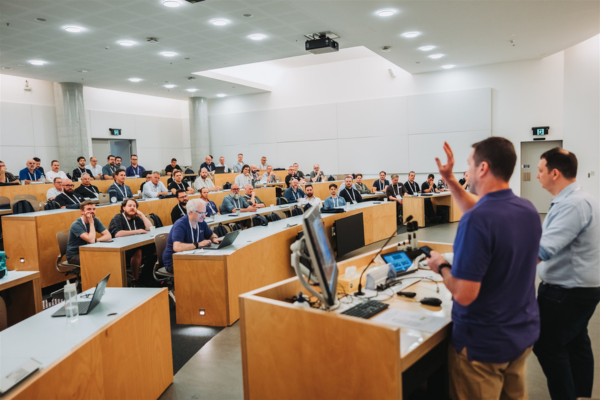
The annual conference for the education AV and IT industry, the AETM Conference, has come and gone. Sean Carroll breaks it down as it happened.
The AV & Education Technology Management Association (AETM) took its talents to Sydney, specifically the University of Technology Sydney (UTS), for its annual conference. With a higher attendance than any AETM Conference before it, the 2025 show was a hit.
ADVERTISEMENT
Tabletop vendors, key associations in the AV world and the brightest minds in the education AV space filled the Dr. Chau Chak Wing Building in the UTS Business School (Building 8). And some bloody stats please, Scott.
Inspired by the idea of a treehouse, the spectacular UTS Business School building was designed by architect Frank Gehry as “a growing learning organism with many branches of thought, some robust and some ephemeral and delicate.”
It looks a bit like somebody grabbed an old 80s-style university campus, scrunched it up into a ball, unfurled it and plopped it back down on Ultimo Road, Sydney.
But the outside isn’t the only notable part of the visual landmark; inside, the building continues to take your breath away. Sculpted polished steel… blobs… frame the initial staircase, and two oval-shaped classrooms are flanked by 150 large timber beams.
Sustainability played a large role in the building’s ethos, and it’s the first UTS building to be awarded a 5 Star Green Star Design rating certified by the Green Building Council of Australia. In addition to sustainably sourced construction materials, interior furnishings and timber, a 20,000L tank on the roof harvests rainwater for use in toilets and for irrigation, reducing potable water use. Fire system test water is also collected and recycled.
Day one of the AETM Conference featured AVIXA training, helping integrators get their CPD points before a welcome dinner. From there, the show was jam-packed with sponsor presentations, member university sessions and networking opportunities.
“The 2025 conference was a resounding success. We had record numbers, which provided for a really engaging delegation, lots of networking and sharking of knowledge,” AETM president Scott Doyle said.
“Our annual conference dinner was again a highlight, listening and watching the conversations and AETM members simply displays the strength of the community we have built over many years.”
Designing solutions with people in mind
Mike Pedersen, AV experience manager at Iowa State University and delegate from AETM’s US-based sister organisation, the Educational Technology Collaborative (ETC), presented at this year’s conference.
As an industry veteran, Mike knows all about what goes into a space from a technology point of view, but he said he has recently dived deep into design philosophy. After stumbling across what he dubbed the “bible” of this area, The Design of Everyday Things by Don Norman, Mike asked himself how he could apply the principles outlined in the book to his AV peers.
“The first thing I learnt is that there’s no such thing as human error, only bad design when it comes to technology,” he said.
Don Norman outlined seven stages of action in design:
- Goal: What do I want to accomplish?
- Decision: What are the alternative action sequences?
- Sequence: What can I do now?
- Execute: How do I do it?
- Perceive: What happened?
- Interpret: What does it mean?
- Evaluate: Is this okay? Have I accomplished my goal?
These stages should help shape the reasons why people design… well, everything. By applying these stages, called the human information processing stages, designers can get a greater understanding of what the intended outcomes of a solution are.
For the AV industry, taking a step back and evaluating a space can go a long way in creating better outcomes for all.
Mike said that he often sees the AV industry get stuck in what Norman calls the Gulf of Evaluation: “We need to ask ourselves, do we even know what we want to do? What are the steps I’m taking in designing a room to achieve the goal I have set out for myself?”
The issue that Mike found the industry struggles with the most is called affordances, something Norman defines as “the perceived action of an object.”
“If there isn’t an established relationship between something the user wants out of a solution and what the designer has created, there’s going to be a clash and an issue will arise,” Mike explained.
Norman writes about signifiers, which give an indication of how to use an affordance. For the AV world, there are several examples of this, including colour coding, visible sliders, greying out buttons and literal instructions taped to the tech…
“The key is making things visible and easy to read. By colouring things properly and ensuring text is legible, there shouldn’t be any struggles with affordances,” Mike outlined.
“For the example of a control panel, one of the biggest issues in our space, we could swap our current ones out for a larger, 15” screen so that it’s easier to see, but then we might be squeezing in too many buttons, again confusing the end user. It’s all about balance when it comes to design.”
One of the most important takeaways that Mike had from his time researching this field is the importance of feedback: “The user needs immediate status feedback so that they’re not left stranded without the correct information at all. This could be in the form of graphics or lights on a panel, but just something to indicate that it’s working as it should.”
Think of it like a red light on a studio camera. Nobody has to worry if the cameras are rolling because everyone understands it’s working because of the universal signifier.
“Universal signifiers, or standardisation, can go a long way in building into long-term memory to help users make the correct evaluation and effective decisions in the future,” he said.
The “future” of the AV/IT technician
Could you imagine walking into work one day and someone says that they’re aiming to get rid of your colleagues, combining some of your role with another (that you’re not familiar with) and that this will help you work more efficiently?
Well, 12 months ago, when the University of Technology Sydney (UTS) employees were enjoying their summer holidays, a draft change proposal hit the ICT department with some… extraordinary proposals.
UTS’s Sofie Loizou and the University of Sydney’s Jerome Mouron explained what changes were included in the proposals and what they aimed to change about the role of the AV and IT technicians.
“The draft change introduced the ‘universal technician’ as part of a larger aim to improve service consistency. A noble cause, perhaps,” Sofie explained.
“This role was also created to address headcount issues while improving service quality. We, with the AETM, relayed concerns about the change and what it could mean for the industry.”
The day after the 2025 AETM Conference, the two speakers, among many others, went on strike to protest against the changes.
The universal technician was a hypothetical mix of roles between AV installation and maintenance, as well as desktop support. It was broad and vague. When Sofie brought up her concerns about the lack of transparency about what the role entails at a town hall meeting, she was told to “Google it.”
“We were told that this new role was a combination of AV and IT and has worked well in small-to-medium-sized universities, according to the consulting firm they contracted. They then said there’s no reason why it shouldn’t work in larger educational institutions,” Jerome explained.
Sofie added that after listing her complaints with the new “role” and not hearing much in response, she took it upon herself to collect her own feedback from the industry. After compiling anonymous feedback from her peers, she was able to list challenges with the universal technician role, including:
- Role merging challenges: Someone working in live studios would struggle to also take on shiftwork needed in other parts of the industry.
- Workload issues: By condensing roles, there will be a higher workload for those on the ground, leading to slower response times for AV and IT tickets (not the other way around, which was suggested).
- Operational complexity: Shift work vs. full-time work and how the job would get done.
- Lack of accurate data and attribution: The data presented by the consulting firm lacked any attribution to real-life studies or feedback.
After presenting this data to the universities, there was a workshop to essentially explain all that’s needed in this space and what would go into the universal technician role. To gather more information, there was a survey sent out through the AETM mailing list in early 2025 with five yes/no questions and one for a detailed response.
“AV technicians, understandably, believed in the importance of AV managers, while we found that smaller institutions reacted more positively to the combined role,” Sofie explained.
Jerome concluded by saying that after receiving feedback from over 180 industry members, the team couldn’t identify one in favour of introducing the universal technician role.
“Specialisation matters. It takes time for each role to have its own training, certification and set of skills. It’s not one role. Training needs investment. Cross-roles are good, but there needs to be proper structure in place, not just a third-party cutting down on headcount,” he said.
“Hopefully, by the 2026 AETM Conference, we will have even more feedback from members and can give a better update.”
What’s going on across the pond?
The University of Aberdeen’s Mark Dunlop is the departing chair of SCHOMS, the UK professional body for senior managers and technology managers in higher education. Every year, he delivers a session on what the AETM’s sister association has been up to and this year, he gave his final talk.
One of the biggest advancements for SCHOMS in the past 12 months has been developing and launching the Development, Education, Learning, Training and Apprenticeships (DELTA) Framework for support staff. The aim of this framework is to standardise educational levels against a common baseline and, in turn, create a development pathway for everyone doing professional AV work.
Ideally, at the end, everyone in the industry (from management to staff to leadership) will understand their role in the industry and where they fit in.
Through a series of workshops, SCHOMS identified that there are 15 core areas and a further eight pathway-specific areas for them to develop.
Mark introduced this framework to the AETM during his session and invited people to email [email protected] to learn more and see if it’s applicable to the APAC industry.
The DELTA Framework also aims to tackle the issue of attracting new staff to the industry, a problem plaguing not just the education space but the AV industry as a whole.
“How do you tell a school-leaver that they don’t need a master’s degree in ancient history? How do we tell them that there’s an exciting career opportunity right there in AV?” Mark asked.
With the DELTA Framework in place, SCHOMS joined forces with AVIXA to attend several career roadshows where they had technical demos and interactive screens and tried to tell as many schoolkids about the world of AV.
Mark noted that the SCHOMS stand was across from the armed forces booth, which had a tank on its booth aimed right at them. While it was unsettling at first, it actually lead to quite a bit of foot traffic, which helped make the day a success.
“One of the most successful elements of our booth was showing the wide range of what AV encapsulates,” Mark said.
“We spoke to one kid who sets up eSports tournaments for his friends on the weekend, setting up all the cables and making a central screen so that his other friends can view what’s going on. It was great to tell him that what he does for fun on the weekend is actually a real-life job that he could do when he finishes school.”
-
ADVERTISEMENT
-
ADVERTISEMENT
-
ADVERTISEMENT
-
ADVERTISEMENT