
Advance Paris X-A220 EVO Mono Power Amplifier
Combining sophisticated engineering with a staggering 220W of power, the latest amplifier from Advance Paris certainly catches the eye. Stephen Dawson checks it out.
For many years, I used a pair of Marantz monoblock power amplifiers in my home theatre system. Of course, I also used a home theatre receiver – many over the years, often on loan. But there were few such receivers really suitable for driving my very difficult front stereo pair. These had a nominal impedance of just 3Ω. A surprising number of receivers have, over the years, specified support for speakers of no less than 6Ω.
ADVERTISEMENT
Those amps offered 400W into those speakers. I’d plug them into the line level front left and right outputs. Some receivers are actually permitted to re-allocate that pair of built-in amplifiers to other channels.
I mention this because I can see that being one enticing use case for the Advance Paris X-A220 EVO Mono Power Amplifiers.
But just one. These days, I’m pretty much a stereo-only guy, so that was the context in which I spent a few weeks with a pair of them.
What is it?
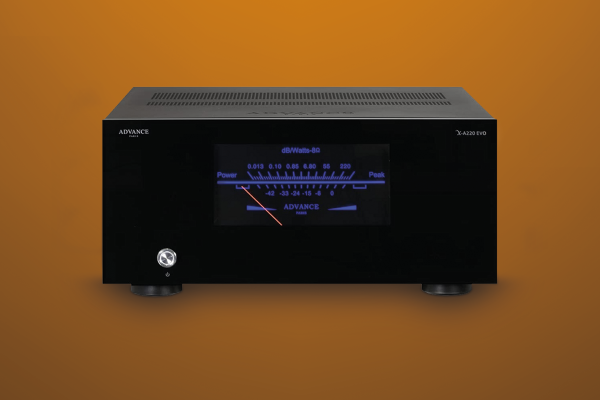
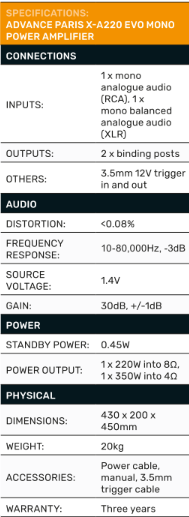
So, yes, the Advance Paris X-A220 EVO amplifiers are monoblocks. Unlike those old Marantz models, though, they’re far from compact. Each weighs around 21kg and occupies around the same volume as a high-end home theatre receiver: 430mm wide, 200mm tall and 450mm deep. They have clean, elegant, if squarish lines, with a 12mm thick glass-like methacrylate plate over the front.
The front of each has a power/standby button towards the lower left, with a ring of illumination around it (white for on, red for standby). Towards the bottom right are the words “High Bias” in a small font. These are softly backlit when that function is engaged. We’ll return to that in a while.
But dominating the front of each is a 190mm by 90mm tall window showing a huge analogue VU meter. This is backlit with a blue scale and a red needle. This is labelled “Peak”, that is, it is intended to show instantaneous peak power (as closely as possible with an analogue system), and is calibrated for watts into 8Ω, along with decibels, referenced to 220W.
Around the back are the connections and more controls. On each, there is a single RCA unbalanced input and a single balanced XLR input, along with a small toggle switch to select between them.
Output is via a pair of hefty gold-plated five-way binding posts. The transparent plastic nuts have a sufficient diameter to allow a good grip on spade lugs (which is what I used) with finger tightening alone.
There are 3.5mm sockets for 12V triggers in and out. I daisy-chained from my preamplifier so that both amps would come on whenever I switched on the whole system.
A slide switch is provided for two levels of brightness, or to switch off completely, the VU meter illumination. Next to that is the High Bias slide switch.
Bias and Power
Each amplifier is rated at 220W into 8Ω and 350 watts into 4Ω. You can use them with low impedance loudspeakers with confidence.
Each amplifier is powered by a 700VA transformer, with four 10,000µF, 80V capacitors to smooth the power supply’s output and ensure there are plenty of reserves. It’s worth noticing something at this point: 700VA is roughly 700W (the difference between VA and power is to do with phase shift). The maximum rated output is 350W. Which suggests that each amplifier can deliver exactly what is claimed.
So what, you may ask. I’d suggest you look at the back panel of just about any home theatre receiver and see what power rating is claimed for it. Then, tote up the maximum power available from all the channels. You’ll see that this figure is much, much more than the rated power input. This is, I suppose, fair enough because in the real world, a home theatre receiver will never be called upon to deliver full power from all channels at the same time. Still, it’s good to see a proper power supply in these monoblocks.
Now, what was that about High Bias? The amplifier uses a conventional Class A/B design. As a reminder: Reduced to basics, a Class B amplifier uses two output transistors. One handles things when the signal is positive, while the other does the amplification when the input signal is negative. Remember, the signal is switching from positive to negative, negative to positive, a lot.
But that point where the signal switches from positive to negative – called the crossover point – and is thus handed off from one output transistor to the other, is non-linear because it takes a moment for a transistor to switch on. This introduces “crossover distortion”, which typically involves a lot of high-order harmonics, which are particularly irritating to the ear. Some early solid-state amplifiers – we’re talking about the early 1960s – were Class B and usually exhibited this problem, contributing to the early perceptions of transistor amplifiers sounding harsh and unmusical.
Class A amplifiers “bias” the signal, so that the midpoint isn’t zero, but halfway up the scale of the single transistor’s range, so that the positives and the negatives never “crossover” at all. The problem with this is that even when there is no signal, the amplifier is operating at half power, so it uses a lot of energy and generates a lot of heat.
It was only a few months ago that I reviewed a very large, rather chunky Sugden power amplifier for another outlet. It looked like it might be a 200W-per-channel model, but it was rated at only 50W per channel. That’s Class A. Despite these drawbacks, many purists are prepared to accept them for the higher perceived sound quality… if they can afford it.
Class A/B is a compromise. A small bias is applied so that the first 100mW or so of the signal operates in class A mode, and Class B is used as the signal exceeds that. Since the transistor is handling the positive signal, and that handling of the negative is always “on”, there’s no crossover distortion in the pure Class B sense. But there is still a tiny bit of switchover, which is dealt with by negative feedback. That carefully matches the level of the output to the input, compares the two and cancels out any difference. That gets rid of the distortion, but many claim that negative feedback also smears transients. So, more bias means more Class A and a reduced impact of negative feedback.
Advance Paris doesn’t share what bias is applied in regular operating mode, but it’s likely around the 0.1W often used. In High Bias mode, the Class A threshold is pushed out to a full 1W. That means much less need for negative feedback, since an amplifier spends a huge amount more time operating in the 1W region than it does in the tenth-of-a-watt region.
In the manual, Advance Paris notes that extra attention should be paid to providing plenty of cooling space around each amplifier if you use high bias mode.
I did most of my listening with this switched off, and a smaller amount with it on.
Using the amplifiers
I had to take one of my turntables off my cabinet in order to fit in the two monoblocks, such is the space they require. They didn’t seem to run particularly hot, even in High Bias mode, thanks to generous heat sinking. Still, you can’t stack them unless you have shelving that provides sufficient air space all around.
As it happens, a while back I purchased an Advance Paris preamplifier from the same series – the X-P1200 – to use with my regular system. This is a fitting aesthetic match to the pair of X-A220 EVO amps, marred only by the shade of blue of the pre-amp’s display being different to that used in the power amps’ VU meters.
The X-P1200 has balanced XLR outputs available, so that’s what I used. I connected with 6ft Mogami Gold cables. No, I don’t use thousand-dollar interconnects. Mogami cables are used by many recording studios. If they’re good enough to produce the recording, they’re good enough to use in the reproduction chain.
Connecting the power amps to my Dynaudio Contour 20i stand-mounted loudspeakers were Lenehan Audio pure copper ribbon speaker cables with gold-plated spade lugs.
Since this whole setup was 100% analogue, I started with vinyl, but also used plenty of digital, mostly decoded by the DAC built into the X-P1200. At every point, with every source, the sound quality was impeccable. The Dynaudio speakers aren’t a particularly easy load, with a 4Ω impedance and rather low sensitivity. The amps had more than enough power to drive them to whatever level I liked, and I liked much of the music very loud indeed. Even at extremely high levels, the sound remained clean and controlled.
In particular, the bass performance was superb. The speakers are solid to a little below 40Hz, and the amps ensured that they delivered these frequencies comfortably and with good, tight control. There was no flabbiness or overhang.
The VU meters were very pleasing to the eye and can help you keep an eye on overall volume levels. The needle movements tended to lag the signal, I’d guess due to their inertia, given how long they are.
Conclusion
So, the Advance Paris X-A220 EVO mono power amplifiers provide excellent performance. They are easily suitable for both a quality stereo system and for bumping up the performance of selected channels in a home theatre system. And perhaps the most surprising thing about them is their relative affordability.
Manufacturer: Advance Paris
Distributed by: Synergy Audio Visual
-
ADVERTISEMENT
-
ADVERTISEMENT
-
ADVERTISEMENT
-
ADVERTISEMENT