
Psiber CableTool CT50 & CT50HR
When it comes to testing cables, technicians need a foolproof solution that doesn’t desert them at the last mile. Myke Ireland checks out the range on offer from Psiber.
We live in a world where plenty of people gravitate toward Microsoft Surfaces, iPads, iPhones and every other shiny device that promises it can “do it all” with the right app and connector, and in most cases, those devices are brilliant.
ADVERTISEMENT
But let’s be honest: When you’re on a worksite, hands gritty and half-sweaty, dust clinging to every surface, dirt getting flicked your way from every other trade in the vicinity, you’re not reaching for your iPhone to start poking around in cable faults.
Even if you did, it’d be wrapped in that oversized shock-proof case with half the ports hidden under rubber flaps that you need three fingernails to pry open.
This is where dedicated testers still earn their keep. In fact, more than ever, there’s a genuine need for purpose-built diagnostic gear. Something you can throw into a bag, pull out with filthy hands, power up without ceremony and expect to deliver the same reliable measurements it did five years ago. Tools that don’t pretend to be anything else.
That’s exactly where Psiber plays, and plays well.
They don’t sugar-coat it. Their gear is exceptional at the things it’s designed to do, and unapologetically not concerned with being anything more. That honesty builds trust. When you’ve got a tester you know will fire up, sync up and spit out dependable results every time, it naturally becomes part of your daily armoury.
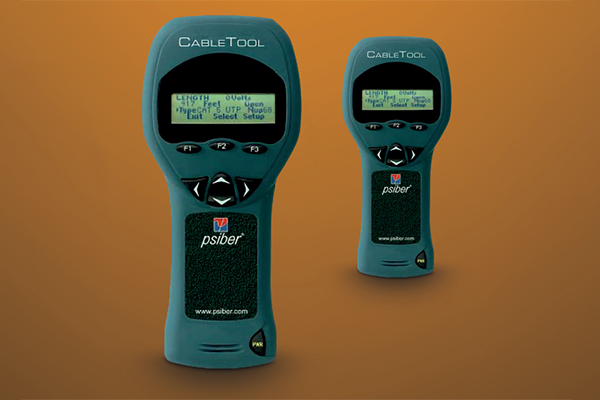
And that brings us to today’s little weapon: The CableTool CT50 and its higher-resolution sibling, the CT50HR. Both sit in the same family of time domain reflectometry (TDR) cable fault locators, but the HR variant ups the ante with finer measurement accuracy, more on that shortly.
For now, it’s enough to say this: If you believe in simple tools that do their job exceptionally well, you’re going to feel right at home with these.
Built for the worksite, not the bookshelf
Unfashioned cardboard box. That’s your first impression, and honestly, that’s exactly what you want. Nobody’s lovingly storing a field tester in its original packaging at the end of each shift. The real value is what’s inside.
Crack it open and you’re met with a surprisingly premium little carry pouch. It’s a tough, heavy-duty woven polyester number, nothing fancy, everything practical. The sort of pouch that looks like it’s seen a hundred job sites before it even leaves the factory. The Velcro flap keeps things simple: No zippers to clog up with grit, no hinges to snap, just a rip-open, rip-shut solution that suits the environment it’s made for. Around the back, you’ve got a sturdy belt loop plus a clip ring (one of those semi-circle jobbies you thread onto whatever you’ve got handy). Everything about it tells you: Throw me on the tool belt and forget about me until you need me.
Inside the pouch, Psiber keeps it just as straightforward. Two pockets: One for cables, adapters, alligator clips, banana plugs, maybe some spare batteries; the other for the CableTool itself. No over-engineering. No unnecessary compartments. Just a simple, durable organiser that does exactly what it’s meant to.
Take the tester out, and immediately it’s clear this thing was bred for fieldwork. The shape is unexpectedly ergonomic, easy to grip, comfortable to hold all day, and reassuringly solid. The chassis is full plastic with a slightly rubberised feel, giving it that extra grip when your hands are sweaty, dusty or generally in “tradie mode”.
The buttons follow the same philosophy: old-school, tactile, chunky push buttons with plenty of spacing. These aren’t touch-sensitive, haptic or pretending to be clever. You press them, they click, the device responds. If you’re wearing gloves, even leather job-site gloves, you can easily operate everything without fumbling.
Then there’s the display: A classic LCD panel straight out of the 80s calculator era, and I mean that as a compliment. High contrast, bold text, instantly readable. No squinting, no shallow viewing angles, no menus buried in stylised UI fluff. The only omission here is a backlight. In low-light roof spaces or under floors, you’ll find yourself wishing it had one. It’s a minor inconvenience, but one that’s easily mitigated in today’s LED age.
At the bottom is the power button, nicely recessed and out of the way, but if you’re right-handed, you might notice the occasional accidental flick depending on your grip. Left-handers will breeze through without issue. Also along the bottom edge: The speaker, which we’ll talk more about later.
Up top are the business-end connectors: Two large, chunky terminals for the positive and negative testing leads. They’ll take alligator clips, banana pins, or whatever breakout you prefer. These are the only openings on the unit aside from the speaker port, which adds to the rugged, sealed-up feel.
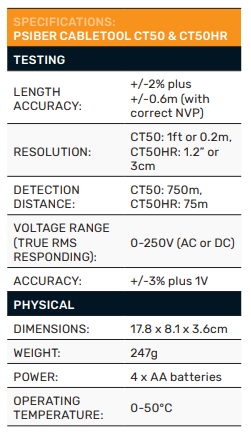
Round the back: A four-AA battery compartment. Psiber rates it at roughly 16 hours of operation, which realistically translates to days of continuous onsite testing or a month or two of periodic use in a typical toolkit.
If you’ve not caught on thus far, at its core, the CableTool series is designed to do a small set of jobs and do them exceptionally well.
Oh, and getting back to that TDR acronym, both the CT50 and CT50HR are TDRs, which means they specialise in identifying faults along a cable’s length and telling you exactly where the problem sits. Whether the issue is a short, an open, a crush point or a break somewhere mid-run, these testers give you a distance-to-fault reading that lets you head straight to the source rather than pulling an entire run apart.
Distance-to-fault measurement
This is the bread and butter of the device. You hook onto a pair, hit the test button, and within seconds, the CableTool gives you:
- Distance to open circuit
- Distance to short circuit
- Distance to any significant reflection point caused by physical damage or impedance change
The measurement is based on the velocity of propagation (VoP) of the cable, something you can adjust if you need absolute precision or leave on default if you’re working with common cable types.
CT50 vs CT50HR: What the extra resolution buys you
Functionally, both devices do the same tasks, but where they differ is in the granularity of the readings.
The CT50 is great for general-purpose field work. It has resolution is perfectly adequate for longer cable runs and really is ideal for domestic, light commercial, or situations where “within a metre or two” is more than enough to find the fault. Think rough in stage type access.
The CT50HR is equipped with a higher resolution TDR engine, which, put simply, means it pinpoints faults with tighter accuracy. Now this is particularly useful for shorter cable lengths, patch panels, racks, or any environment where a few centimetres matter because it lets you distinguish between faults that sit very close together (for example, near a connector or plug).
Think of it as the difference between a good tape measure and a precision steel rule. They’ll both get the job done, but one lets you interrogate the fine details.
Cable length measurement
Both units can measure total cable length, which is useful for verifying installed runs or confirming whether you’ve hit a join, a break or the end of a reel. Again, the HR variant gives a tighter reading, but the functionality is the same.
Tone Generation & Probe Compatibility
A feature worth calling out is the built-in tone generator. Either unit can send a tone signal down the cable pair you’re connected to, which can then be picked up using an inductive probe or amplifier probe. This helps with:
- Identifying the right cable in a bundle
- Tracing cable paths through ceilings, walls, or racks
- Locating specific cores inside multi-pair cables
Psiber’s tone system allows the probe to separate multiple signal types depending on the probe model you’re using. So, if you’ve fired a tone down one pair and somebody else is tracing a different one nearby, a decent probe will help differentiate those signals without guesswork.
It’s simple but extremely practical, especially on messy job sites where cable identification quickly becomes a spaghetti nightmare.
Final Thoughts
Ummm, and you know what? That’s kind of it… It’s one of those “it does what it says on the box” articles, because as we’ve mentioned. It does what it says on the box.
So, I’ll finish the same way I opened. There is still a market in this world for affordable, reliable, accurate pieces of kit, that are simply good at one little thing. The brotherhood of the CT50 and the CT50HR is exactly that.
Manufacturer: Psiber
Distributed by: Kordz Australia
-
ADVERTISEMENT
-
ADVERTISEMENT
-
ADVERTISEMENT
-
ADVERTISEMENT