
Reference audio level for home cinema
Integrators are in a position to offer the highest quality of audio for home cinemas. David Meyer explains how to perfectly blend all technology, not just throw in the most expensive gear.
In past issues, I’ve written about the RP22 Immersive Audio Design recommended practice and its upcoming companion, RP23 Immersive Video Design. This time, I’m homing in on one detail of RP22, that of sound level capability (for those familiar with RP22, that’s Section 6.1.4 with performance parameters 12-14), comparing it to the reference audio level of content.
ADVERTISEMENT
The nominated sound pressure level (SPL) figures in RP22 centre around the 105dB reference of commercial cinema, as recommended for screen speakers in an RP22 Level 2 system and a minimum for Level 3. Performance Level 1 is 6dB below this, while Level 4 is 6dB higher to maximise the dynamic envelope.

This raised questions among some folks about where the numbers came from, so the CEDIA Standards working group that developed RP22 set out to explain. But in doing so, they went down an interesting rabbit hole of variables.
The result was a new CEDIA technical white paper titled Reference Audio Level and SPL Capability. I was fortunate to be included in this process, and while I encourage reading the paper, I wanted to share some of my observations and interpretations here.
For one thing, they’ve shone a spotlight on the fact that audio mixes for the home (known in the post-production community as the “near-field” or “home entertainment” mix) don’t have the same consistency between studios as the theatrical mix for commercial cinema release. “Reference” is not just one number, and that can have implications on how it sounds in the home.
How we hear at different sound levels
The way we hear the full range of audio frequencies differs depending on how loud it is. We’re more sensitive to upper midrange (around 3.5-4kHz) than we are to high and low frequencies, and the differential widens as the sound level decreases.
Back in 1933, research into this phenomenon resulted in the Fletcher-Munson equal loudness contours, as pictured below. Britannica defines it well: “The curves show the varying intensities of a pure tone that has the same loudness to the ear at various frequencies.”
And in case you’re wondering, “phon” is the unit for perceived loudness. Each contour (red line) is pinned to its corresponding sound level (Y-axis, in dB) at the 1kHz mark.
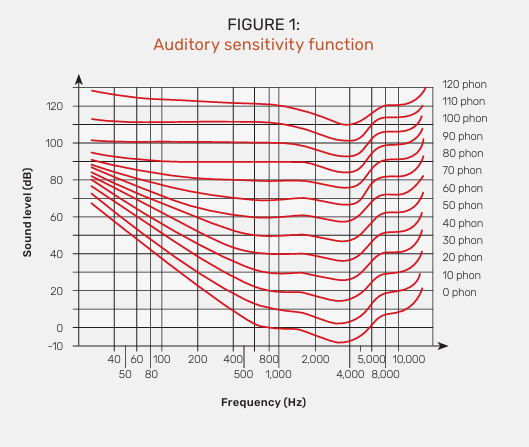
For example, tracing the 60 phon contour, 1kHz at 60dB would be perceived as the same loudness as 45Hz and 16kHz at about 80dB, or 3kHz at about 58dB. Another way of looking at it is that if all frequencies were the same sound level, 45Hz would sound like it’s 20dB quieter compared to 1kHz. Considering a 6dB SPL drop generally represents a halving of perceived loudness, that’s a huge amount! But crank the volume up to 100dB at 1kHz (100 phon) and the contour flattens right down to 40Hz.
For any keen video folks that may be reading this, it’s analogous to the gamma curve (albeit much more complex) to account for how our vision is more sensitive to grey, the midrange of contrast, than it is to black or white.
In practice, these equal loudness contours explain why even an untrained ear can easily discern that music that sounds “full” at one volume will seem to lose some treble and especially bass, relative to midrange, as the volume is turned down. It’s not necessarily the audio system changing the sound; it’s our ears and aural perception.
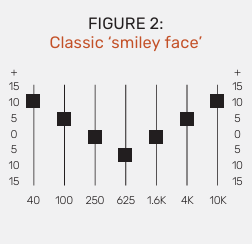
That’s what the loudness button is for in basic systems; it’s a one-size-fits-all compensation for low volume. It also explains why people like the classic “smiley face” graphic equaliser pattern to trim midrange back a bit while boosting bass and treble. But if used, this should also just be a low-volume thing. As the volume is turned up, the contours smooth out especially below 600Hz, so it can get boomy if the volume is turned up without readjusting (but hey, some people like that too! Ugh).
Reference level
The equal loudness contours demonstrate two important interrelated things:
- The need for audio engineers to mix and EQ the content they’re creating at the sound level that it’s intended to be played back
- The need for playback systems to have a flat frequency response so that they can most accurately reproduce the content from point one
Now consider what happens when a movie is mixed in a studio at 85dB to best convey the artistic intent, is played in a cinema that’s calibrated to 85dB, but the volume is turned down to an average 70dB. High frequencies would attenuate a little (notwithstanding the X-curve, for those who are familiar). Crucially, bass would likely be down 6dB or more. Not good. Conversely, if it was mixed to sound optimal at 70dB but played back at 85dB, the opposite would happen, likely sounding bass-heavy.
It is therefore necessary to match, as best as practicable, the mixing and intended playback levels. That’s what is known as the reference level, the goal being to deliver end-to-end consistency and preserve artistic intent.
For decades, 85dB average (typically using dialogue as the anchor) has been the reference for theatrical mixes, with 20dB of headroom above that for the louder parts of a soundtrack. That’s where the 105dB number in RP22 comes from — it’s 85dB reference + 20dB of dynamic headroom.
But some say that’s too loud, even for commercial cinema.
When is loud too loud?
During the discussions that led to the white paper, the CEDIA Standards working group connected with several independent authorities in cinema audio. There was a general feeling among them that 105dB is often too loud. But experts in the CEDIA Standards group quite rightly pointed out that distortion is often the problem. A dynamic soundtrack with 105dB peaks may be perceived as uncomfortably loud if the system is distorting even a little, but if it’s distortion-free, then peaks up to 105dB are more immersive and should not be fatiguing.
Keep in mind there are also safety considerations, and not just for the amplifiers and speakers. Multiple sources cite that permanent hearing damage can occur after hours hours of constant general exposure at 85dB, six hours at 95dB or as little as 15 minutes of in-ear exposure (ear buds) at 105dB. Workplace safety laws in many jurisdictions place time restrictions on exposure at 105dB without appropriate hearing protection.
But in a movie, such levels might occasionally only be reached for a matter of seconds or a couple of minutes at a time. Occasionally longer. As such, the warnings don’t apply. Music concerts are generally far louder for longer!
It’s also recognised that small rooms will typically sound louder than large rooms at the same SPL, especially one with little or no acoustical treatment. This is because the shorter travel times and increased reflections can increase the sound density, even if it measures as the same SPL. As such, it’s widely accepted practice to mix audio tracks intended for small rooms at lower reference levels. Audio mixing studios do just that, literally in smaller rooms to approximate the size of the intended playback spaces and on nearfield monitors to produce a home entertainment mix for consumers.
The problem is that different studios use different reference levels and different-sized rooms. So, inspired by work of CEDIA Standards, I went looking for examples.
Home entertainment mixes
I looked into just a few studios to get a feel for what they’re doing. It’s a mixed bag. Disney, Netflix and Warner Bros. are aligned in their near-field reference levels, nominating 79dB or 82dB (C-weighted) plus 18-20dB of headroom, based on Dolby Atmos near-field specs, while Paramount appears to stick to the theatrical standard of 85+20dB. Sony Pictures Entertainment are more conservative at 75-79dB plus 20dB of headroom.
The common number between the majority is 79dB. If settling on 20dB headroom to cover all bases, that arrives at 99dB, aligning with RP22’s performance Level 1 minimum guideline. Voila.
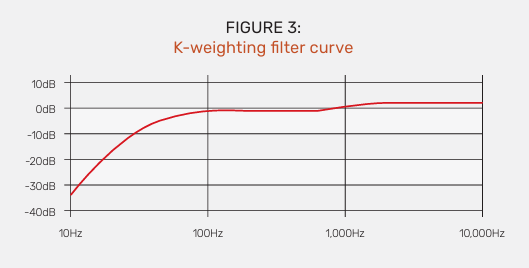
All the abovementioned content creators, in addition to a multitude of others, including HBO, Apple, Amazon and legacy TV networks, etc. also apply a “loudness normalisation” contour. Known as K-weighting, it’s defined by the ITU-R BS.1770 standard and is the basis for A/85 (ATSC) and EBU R128 (Europe) standards.
For those who want the surety of theatrical mixes for their best-of-the-best private theatre, some high-end designers can arrange Digital Cinema Package (DCP) content via commercial processors and subject to digital rights management (DRM), typically costing thousands of dollars per title to watch.
So, what does this all mean?
Well, as much as the idealist in me would like to think that most private entertainment spaces are optimised according to RP22, the reality is that only some premium dedicated spaces would qualify.
The typical home cinema system out there is in a shared space with a relatively high noise floor and little or no acoustical treatments. It’s probably not calibrated, the frequency response is far from flat, and the owners find themselves turning the volume up for quiet dialogue scenes and down again during action sequences. Rinse and repeat.
As a pragmatist, I’ve always thought the true measure of success of a system is whether the owners are happy with it, but that also depends on whether they really know what’s possible to compare.
In any case, it’s important to equip an immersive audio system with sufficient power capacity to deliver distortion-free playback at the highest intended levels — think loudest peaks when demoing the system to friends. But for everyday use, the system should sound its best if calibrated to the typical intended playback level. You can’t control the reference level of content, back you can optimise the system in the space. Beyond that, there’s always a volume control.
-
ADVERTISEMENT
-
ADVERTISEMENT
-
ADVERTISEMENT
-
ADVERTISEMENT