
Untangling network cabling standards
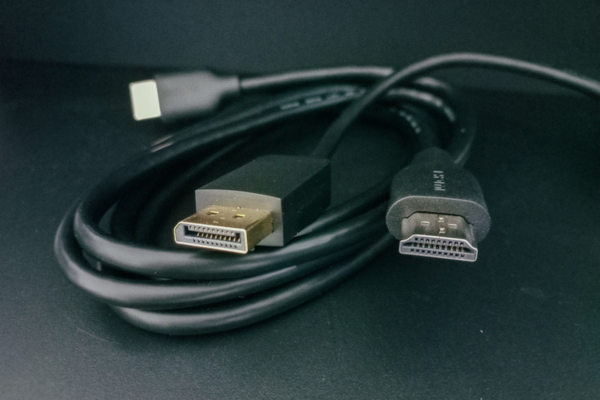
Standards are constantly evolving, especially in the technology world. David Meyer explores the network cabling standards and what they mean for integrators.
Those who have known me long enough will remember that I’m a cable geek from way back. In fact, it was around 2000 that I started seriously paying attention to the difference decent cables can make.
ADVERTISEMENT
That was back when component video was king, TOSlink still wowed people, DVI was cutting edge, HDMI wasn’t a thing yet and Cat 5e — along with home networking generally, including wireless (who remembers Apple AirPort?) — was still brand new and in very early adoption.
As much as many cable types have transformed over the intervening years, the performance of connected systems still hinges on the integrity of the interconnecting cables, as always.
I didn’t know it at the time, but embarking on understanding why issues occurred and seeking out quality cabling solutions set my trajectory in this industry. It’s seen me work closely with connectivity standards since 2005.
But the last time I penned an article on the topic was The Future of Connectivity (Connected, August 2021), and since then, things have continued to march forward.
Today, however, I’m just going to focus on network cabling, namely the importance of interpreting standards properly, before looking into Single Pair Ethernet (SPE).
So many standards
Anyone working with standards can relate to the famous quote from Dutch computer scientist Andrew S. Tanenbaum: “The nice thing about standards is that you have so many to choose from.”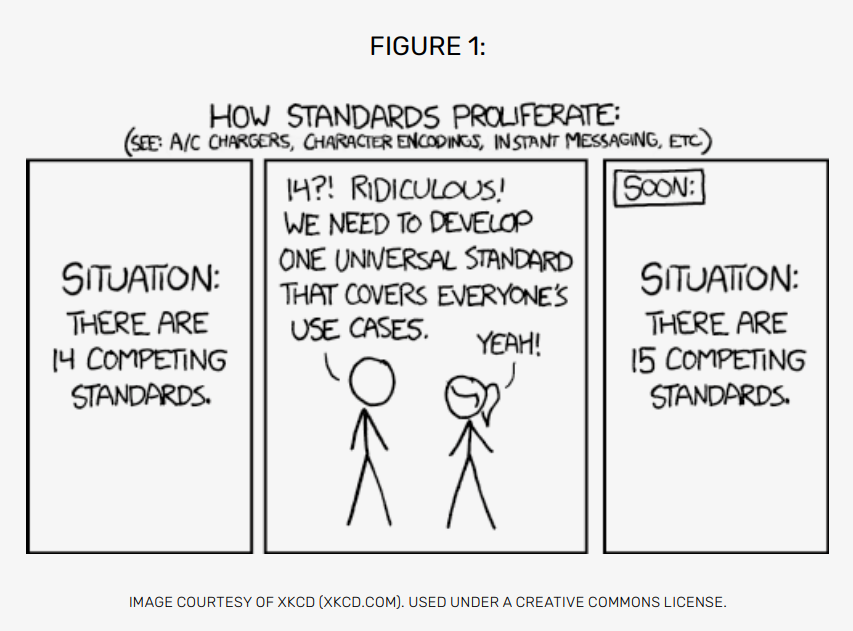
Sometimes having a lot of standards can be a really good thing. For instance, general networking and the internet result from literally thousands of standards from several different organisations (IEEE, IETF, 3GPP, etc.). However, for the most part, they assemble brilliantly to enable seamless interoperable communications spanning wired, wireless, and mobile networks globally.
But sometimes having too many standards can cause contradictions and confusion, needing cross-referencing and context to be interpreted and applied appropriately. Something I can personally attest to.
Example 1: Currency of Cat 5e & Cat 6 Cables
The Cat 5e cable standard debuted in 1999 (yep, 20th-century technology!), Cat 6 in 2001, Cat 6A came many years later in 2009, and Cat 8 in 2016. They were all specified by the Telecommunications Industry Association (TIA) based in Virginia, USA.
By 2018, home networks had evolved a lot, and 10/100MbE was obsolete, Gigabit was ubiquitous, with 10GbE the premium option. That was when revision ‘D’ of the TIA-570 Residential Telecommunications Infrastructure Standard came out, and I’m guilty of having promptly misinterpreted it at the time. Let me explain.
The TIA-570-D standard included a “Recognised cables” list, nominating Cat 6A with an option for using Cat 8 to construct Cat 6A channels. I (wrongly) interpreted the total omission of Cat 5e and Cat 6 as them no longer being recognised, effectively outmoding them. Given it was the latest of all the TIA network cabling standards at the time, I had no basis to really question it, even though I thought retiring regular Cat 6 seemed very premature.
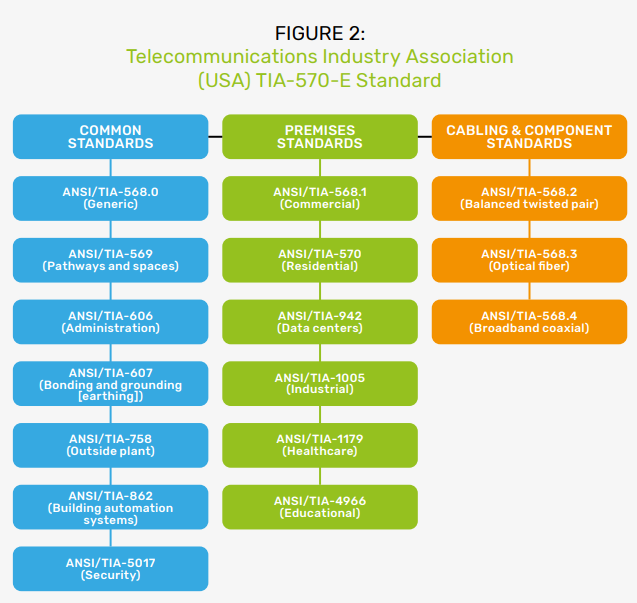
Then, when revision ‘E’ of the ANSI/TIA-568.0 generic standard (top of the blue stack in Figure 2) was released in 2020, lo and behold, it still recognised “Cat 5e or higher”. So, they weren’t outmoded after all. Good news, I guess, but a little confusing too.
The status of these cables was indisputably confirmed in 2024 with the release of revision ‘E’ of ANSI/TIA-568.2 (top of the yellow stack). As far as category cables go, this is essentially the standard that rules them all. Notably, it still includes 100MHz Cat 5e as a valid, current cable specification. That’s settled then.
So, where did I go so wrong with misinterpreting TIA-570-D back in 2018? It seems I overlooked one crucial detail — in its introduction, the document states that it “is intended for implementation of new construction, additions, and remodelled single- and multi-dwelling residential buildings.”
What was meant was that Cat 6A was the recognised cable for new cable runs, but that didn’t mean that Cat 5e and Cat 6 weren’t still valid for existing runs. It just didn’t say that anywhere.
In effect, I misinterpreted one omission due to another. It took later revisions of other relevant standards for the accurate picture to become clear. My point is that interpretations can take some investigation. And never assume! Sharing my error may not reflect well on me, but I’m comfortable with that if it can help others. I just thought it was a perfect example of how easily misinterpretations can occur.
Example 2: Cat 7 Cable
Now this is one that I was always clear on, but I know it can still be a minor source of confusion.
The naming convention of category cables implies that Cat 7 is the step up from Cat 6A. On paper, it is — 600Mhz vs 500Mhz, respectively — but in practice, it’s not. Cat 7 was developed by ISO/IEC in 2002 as part of the 11801 standard. Cat 7 was never formally recognised by TIA. Furthermore, it was intended for use with specialised GG45 or TERA connectors, not RJ45, though adaptations were adopted later.
By comparison, Cat 6A is a much later specification (2009), specified by TIA specifically for use with RJ45s. This is an important point because it made Cat 6A backwards compatible, not to mention easier and more economical to terminate. I figure that TIA would have called it Cat 7 if ISO/IEC hadn’t already used that designation. But because its bandwidth was just below that of Cat 7, it logically needed to slot in below it numerically. So, needing to squeeze it between 6 and 7, calling it Cat 6 “augmented” was a good a solution as any. Note that I wasn’t part of its development to confirm this, it’s just my summation; it may have happened differently.
When TIA released the Cat 8 spec for 25/40GbE in 2016 — again only for use with RJ45 for backwards compatibility — ISO/IEC updated 11801 (to Edition 3) to ratify TIA’s application with RJ45s, calling it ‘Class I’, while also specifying backward compatibility with Cat 7 and GG45/TERA connectors, calling it ‘Class II’.
What does this mean for integrators?
When pulling new cables in homes, the TIA says to make them Cat 6A, but that Cat 5e and Cat 6 are still valid with existing infrastructure (for 1GbE). However, the pragmatist in me says that Cat 6 is still the go-to for many new cable runs, especially those under about 45m (depending on gauge). But if you think there’s even the slightest chance of longer lengths perhaps someday being used for 10GbE, then don’t even question it, use Cat 6A to enable future upgrade.
As for any higher spec, the use of Cat 7 is generally declining. There’s absolutely no harm in using it if that’s your preference, and you might not have a choice if it’s specified in a commercial tender, but otherwise, Cat 6A offers many advantages. As for Cat 8, in my opinion, it isn’t necessary. If you want/need better than 10GbE, wouldn’t you just skip Cat 8 and go straight to fibre?
Single Pair Ethernet
Earlier, I mentioned some ‘E’ revisions of TIA standards. I was also talking about the TIA-570 residential cabling standard that was also updated to revision E (TIA-570-E) in 2024. I pored through it to identify the differences from TIA-570-D, and there’s one really big one — the addition of single Pair Ethernet (SPE) in the recognised cables list. The reason that’s such a big deal is that the main use cases for SPE had previously been industrial automation (e.g., robotics) and lightweight in-vehicle networking for the automotive sector, but its inclusion in TIA-570 indicates future use cases for residential.
Let’s back up a bit in case you’re not familiar with SPE. As the name suggests, SPE comprises just one balanced twisted pair under an outer jacket instead of the usual four pairs in Cat cables. As I’m sure you can imagine, that makes it a lot thinner and lighter with a smaller bend radius, also saving huge amounts of raw materials. It’s designed to support bidirectional 10Mbps up to a whopping 1km, gigabit to 40m (depending on application), and 10Gbps to 15m. Add to that 50W of deliverable power with a protocol called Power over Data Line (PoDL) for powering things like sensors, actuators, and cameras.
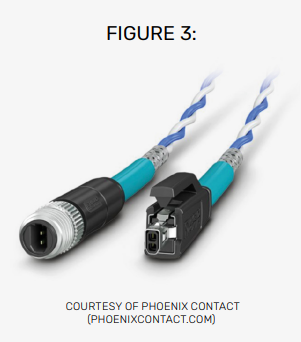
It appears that SPE is not likely to be subjected to another format war either, as there’s some pretty awesome collaboration with the ecosystem. The IEEE defines the protocols, TIA specifies the cable, and ISO and IEC specify connectors (including in IP-rated housings).
One caveat — there’s more than one connector type, which seems a bit of a pain. At the time of writing, I’ve not yet looked into why, but I suspect it’s to suit different industries and applications.
What do you think single-pair wiring could do in the home? How could it be put to good use in place of existing cabling options? I’d be curious to hear your feedback.
Perhaps things like control system interfaces — two wires instead of four — and input devices (sensors, etc.). But we’ve been talking for years about a theoretical future of home lighting going onto a network, powered by PoE and controlled by IP. Perhaps SPE might be a more elegant and cost-effective alternative? Mere speculation.
In closing, standards may be dull, but they’re important. And as it says in TIA-570-E, it’s “a living document.” Standards evolve and advance. Please just remember to investigate, be curious and don’t assume. As always, thanks for reading.
-
ADVERTISEMENT
-
ADVERTISEMENT
-
ADVERTISEMENT
-
ADVERTISEMENT