
Double Bay Project: The home that thinks for itself
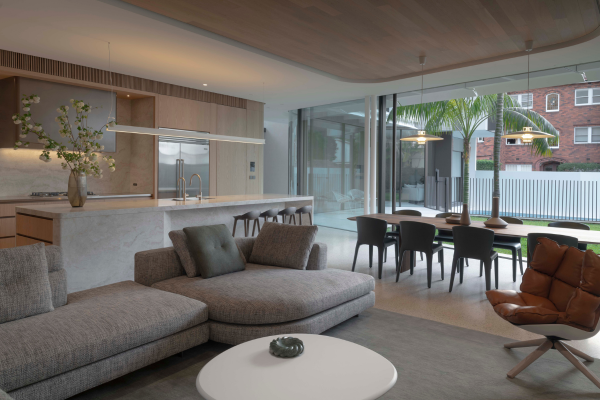
In Double Bay, Ryelec Automation and Toki Construction have created a home where advanced smart-home technology works quietly behind the scenes, seeing the project earn honours from CEDIA. Casey McGuire tells more.
In a prestigious harbourside suburb in Sydney, this residence, dubbed the Double Bay Project, is a showcase of both architectural refinement and advanced technology. Built by Toki Construction in collaboration with Ryelec Automation, the project combines the sophisticated design vision of Stanic Harding Architects and the interiors of Interni with one of Australia’s most complex smart-home systems.
ADVERTISEMENT
This project saw Ryelec recognised with the CEDIA Best Integrated Home Level II across the Asia Pacific region. More than just a house, it is a fully connected home, where every system is integrated into a single, programmable platform.
“We handled all the electrical and automation on the job, from disconnecting the house before demolition to programming at the end,” Ryelec director Tom Ryan says.
Ryelec welcomed the clients into its showroom with a clear vision in mind: To offer something beyond the ordinary.
While C-Bus and Dynalite remain two of the most widely adopted lighting control systems in Australia, the team at Ryelec believed there was an opportunity to take a more forward-thinking path. Rather than defaulting to the familiar, they set out to demonstrate what a truly open and future-ready platform could deliver.
This thinking led them to KNX, the system they ultimately championed as its preferred solution. For Ryelec, KNX represented not just an alternative, but a smarter and more adaptable framework that aligned with their commitment to innovation. By choosing KNX, they were able to show clients what a next-generation control environment could look like, highlighting the freedom, scalability and design flexibility that comes with stepping away from convention.
“We had to make sure that everything we did either disappeared or was high-end design. The switches that we put in are handmade out of bronze. They’re functional, but they’re supposed to be a design statement,” Tom says.
“The reason we put the automation system in is that it allowed us to get rid of all these other little systems, so the walls aren’t cluttered and we just put it into one touch screen to make it all minimalist.”
KNX became the backbone of the entire project, chosen for its flexibility and the sheer breadth of systems it can bring together. In the home, KNX manages everything from lighting control to automated blinds, ceiling fans, air conditioning and floor heating. It also ties into the energy meter for smarter monitoring and links seamlessly with the home’s extensive AV setup.
Across multiple rooms, the system coordinates audio zones, intercoms, access control, security, pool functions, televisions and more, creating one cohesive ecosystem rather than a collection of standalone components.
Tom explains: “It’s a completely open source, so it’s not owned by a manufacturer. That means the clients and us are not locked down to what we can use and who we can buy from. KNX isn’t an actual product, it’s a language that systems talk on.”
One of the key advantages of KNX is just how in-depth it can go, offering integration options that go far beyond typical systems. This allowed the team to achieve higher-level control over air conditioning and floor heating, while providing greater flexibility with blinds and louvres. Weather stations were also integrated, a feature not commonly available in other systems, allowing the house to respond dynamically to outdoor conditions.
Audio was another area where creativity and technical skill came together. All of the ceiling speakers in the house are completely invisible, creating a seamless aesthetic that keeps the focus on the design rather than the hardware. Each speaker was installed flush into the plasterwork, then painted over with a specialised protective coating that allows sound to pass through while hiding the unit entirely from view. The result is a clean, uninterrupted finish where you see nothing at all, yet the room fills with smooth, crisp audio that feels immersive without ever revealing its source.
Alongside the invisible speakers in the roof, subwoofers were cleverly hidden within joinery, delivering rich bass without large boxes on the floor. The garden setup pushed this even further, with speakers concealed among the landscaping and subwoofers buried in the ground. The result is immersive, powerful sound that remains completely out of sight.
The home’s ventilation system also benefited from KNX integration. The HRV system, which circulates fresh air at the house’s set temperature, was enhanced with custom coding and KNX sensors. For example, when someone entered a bathroom, the system would automatically increase airflow, and if humidity levels rose, it would ramp up further to maintain comfort. While this is the kind of setup usually reserved for commercial buildings, here it was implemented on a residential scale.
Even with the architects providing highly detailed plans, challenges still arose. The team anticipated the invisible speakers going into the Gyprock, but the introduction of Venetian plaster added an unexpected layer of complexity. Every detail had to be carefully managed to ensure the result met the project’s high standards of both performance and aesthetics.
“We were really unsure if the Venetian plaster was going to work with invisibles, but we’d already installed the speakers,” Tom says.
“There was a bit of a panic moment there for a week or so, until we got the data sheet back from the speaker manufacturer and they confirmed that all would be good.”
Despite the temporary panic, the team at Ryelec approached the challenge methodically, double-checking every installation point and reviewing the specifications to ensure the speakers would perform flawlessly once the plaster went on. It became a delicate balancing act between maintaining the flawless aesthetic of the Venetian plaster and preserving the integrity of the audio system. Every adjustment had to be precise and communication between the plasterers, electricians and Ryelec team was critical to ensure nothing was compromised.
By the time the plaster was applied, the team had full confidence that the invisible speakers would deliver the crisp, immersive sound they had promised. The experience reinforced the importance of careful planning and collaboration and highlighted how even unexpected hurdles could become opportunities to innovate and refine their approach.
“We learned a lot about the stuff we touched on before, like the energy metering, load shedding, the HRV system and a few technical integrations. It was the first time we integrated into EV chargers to control those as part of the load shedding.”
In a traditional, non-automated home, designers often run into what the team at Ryelec jokingly calls ‘wall acne’. This happens when every controller, like air conditioning, floor heating, intercom, lighting and blinds, is placed together on a single wall. The result is a cluttered and chaotic display of buttons and screens that disrupts the interior’s clean lines and aesthetic. By contrast, a fully integrated KNX system hides this complexity, allowing home owners to control everything seamlessly without ever seeing a tangle of switches and remotes.
“We want to remove all the wall acne and instead just have one touchscreen that does everything those ten other times you’d have on your wall would do,” Tom says.
-
ADVERTISEMENT
-
ADVERTISEMENT
-
ADVERTISEMENT
-
ADVERTISEMENT