
Smart home market set to surge past $1 trillion by 2034 as AI, IoT adoption accelerates

The global smart home market is on track for explosive growth over the next decade, driven by rapid adoption of connected devices, AI and IoT-enabled automation across residential settings.
According to market estimates from Polaris Market Research, the sector is expected to expand from US$157.37 (AU$218.45) billion in 2025 to US$1,081.41 (AU$1,500.91) billion by 2034, reflecting a compound annual growth rate of 23.9%.
ADVERTISEMENT
The growth is being fuelled by rising consumer demand for automated, energy-efficient and connected living environments. Smart home systems now increasingly integrate AI-powered assistants, cloud platforms and machine learning tools to enable real-time monitoring, predictive automation and remote control of household functions.
Security and surveillance remain the dominant application segment, accounting for around 42% of the market in 2025. Connected cameras, smart locks and intrusion detection systems are seeing widespread adoption as home owners prioritise safety and remote monitoring capabilities.
Within product categories, smart security systems represent roughly 35% of total revenue, underscoring the continued focus on safety-driven innovation. Connectivity is also a key enabler, with WiFi-based systems leading at approximately 61% market share due to broad compatibility and ease of deployment across devices.
The report also highlights strong momentum in retrofit installations, which account for around 57% of the market. Rather than new builds alone, much of the current growth is being driven by home owners upgrading existing properties with smart technologies, reflecting increased affordability and accessibility of connected devices.
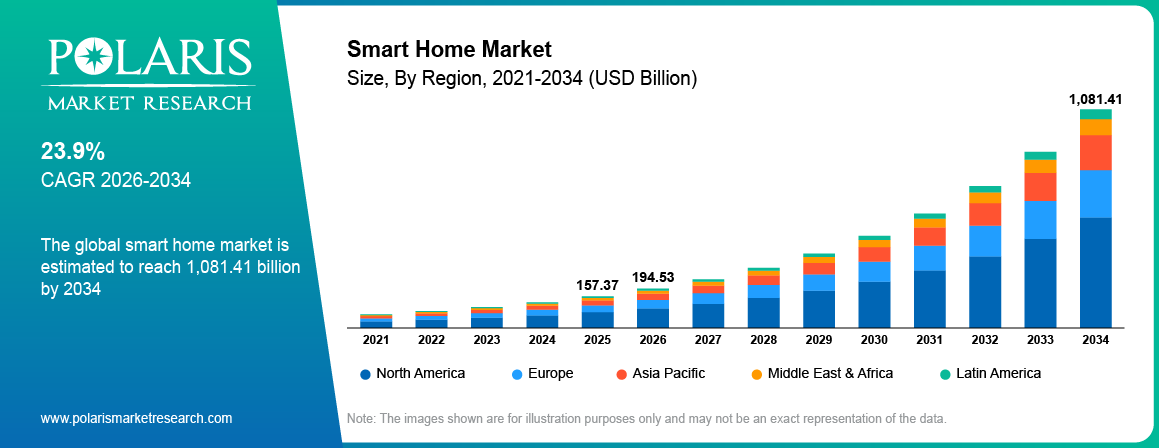
North America leads the global market with about 38% share in 2025, supported by mature digital infrastructure, high consumer adoption and strong participation from major technology companies. However, Asia-Pacific is emerging as a key growth region, driven by rapid urbanisation, rising disposable incomes and government-backed smart city initiatives, particularly in China and India.
Despite strong growth prospects, the market faces ongoing challenges around data privacy and cybersecurity. As smart home ecosystems collect and transmit large volumes of personal data, concerns about breaches and unauthorised access continue to act as barriers to adoption in some regions.
Looking ahead, the market is expected to be shaped by further integration of AI-driven automation, voice-controlled systems and more adaptive, sensor-based environments. The convergence of 5G connectivity, edge computing and advanced analytics is also expected to improve responsiveness and interoperability across devices, pushing smart homes further towards fully autonomous operation.
-
ADVERTISEMENT
-
ADVERTISEMENT
-
ADVERTISEMENT
-
ADVERTISEMENT