
FlatPanel Audio DML500
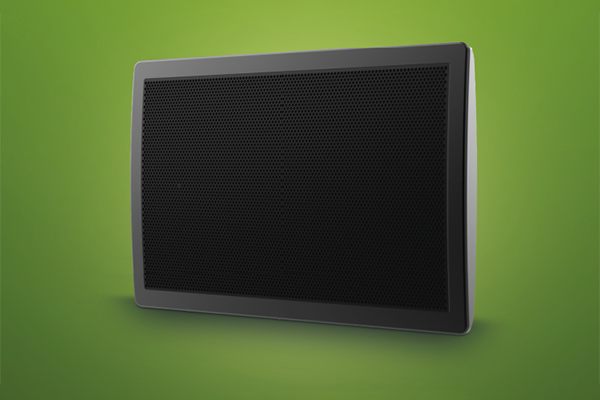
Years of R&D birthed a new loudspeaker technology system that integrators are now using to solve room problems that old-school loudspeakers worsen. Alan Cunningham explores the latest solution from FlatPanel Audio.
Commercial speakers are not usually in my wheelhouse, so I was a little hesitant when I was asked to review the FlatPanel Audio DML500. Most of the speakers I normally spend time with are more domestic hi-fi, home cinema or smaller installed products, so this was slightly outside my normal comfort zone. Still, the DML500 looked interesting enough to give it a proper crack, mainly because it is not just another black box with a horn and a woofer.
ADVERTISEMENT
Unlike a traditional cone speaker, the FlatPanel Audio DML500 uses distributed mode loudspeaker technology. In simple terms, it uses exciters to vibrate a flat panel, rather than using a conventional cone to push air backwards and forwards.
This is similar in principle to the technology used by some invisible speaker manufacturers, where the speaker is hidden inside a wall or ceiling and the surface itself becomes the thing making the sound. The DML500 is not invisible, but it uses the same general idea of spreading vibration across a panel to create a much wider sound field.
The DML500 is a passive speaker and uses four exciters per cabinet. According to the specifications on the box, it has a frequency range of 75Hz to 20kHz, 200W continuous power handling, an 8Ω impedance and 92dB sensitivity.
Those are respectable commercial audio numbers, but the specification that really caught my eye was the claimed 165° of horizontal and vertical coverage. That is a very wide coverage angle, and I was keen to see whether that was just marketing glitter or something that could actually be heard in a real space.
Build quality is solid. The speakers are constructed from die-cast aluminium and feel like they are made for commercial use rather than showroom pampering. They were larger than I expected when first unboxed, although they are only about 90mm deep, which makes them much slimmer than most conventional speakers with similar commercial ambitions.
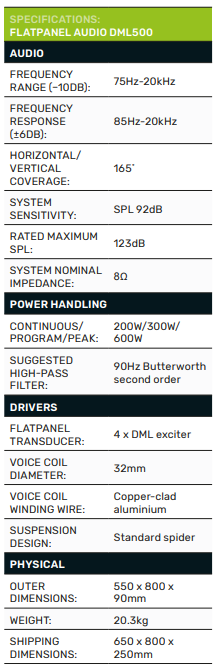
They are still fairly hefty, sitting in the 20kg-plus range and they mounted easily enough on a standard speaker stand, and each speaker has Neutrik Speakon inputs with loop outputs, which is exactly what you want to see in an installed or portable commercial system. The kit I tested had everything you need to set up, all in nice carry bags and cases.
For testing, I used the LEA-supplied amplifier and the FlatPanel Audio LS208 subwoofer. That is worth mentioning because, while the DML500 can produce sound down into the lower midrange, it is not really intended to be a full-range bass monster on its own. For speech, you could run them without a subwoofer in many applications. For music, especially anything with proper low-end content, the subwoofer makes a big difference.
Now, we all come across product reviews, especially with audio equipment, where the review is conducted in a custom-built listening room or small cinema. The room has treated walls, absorption panels, thick carpets with acoustic underlay, bass traps in the corners, and probably a few carefully placed movie posters to finish the look. Those spaces are great for critical listening, but they are not always realistic for commercial loudspeakers. Most commercial speakers do not get installed in perfect acoustic conditions. They get put into gyms, warehouses, churches, halls, airports, function spaces, schools and rooms full of hard surfaces, glass, steel, concrete and people.
So, we have the perfect area to test the DML500s: A large open warehouse with a concrete floor, concrete walls and a high ceiling. In other words, an acoustic headache wearing work boots.
It was not a friendly room, pretty reflective and open, but that made it a much better test for this type of speaker. If the DML500s could perform well in that kind of environment, then the result would be more meaningful than hearing them in a heavily treated room that already makes most speakers sound better than they deserve.
The marketing material suggests that the main applications for the DML500 include larger facilities such as churches, gyms, airports and portable audio systems. That made sense to me once I had them set up. These are not speakers aimed at a single sweet spot. They are designed to cover a large area evenly, with fewer obvious hot spots and dead zones than you often get from conventional directional speakers.
My first test was speech only. I set the speakers about 10m apart, put on a spoken word track and walked around the room. This was the part of the test where the DML500s started to make sense. I was surprised by how wide the dispersion was and how far off centre I could go without losing much level or clarity. With a normal speaker, especially one using a horn or more directional high-frequency driver, you can usually hear the tonal balance change as you move off axis. The top end drops away, the voice becomes less direct or one speaker starts to dominate the other.
With the DML500s, the sound stayed much more consistent across the room. I could move well outside the space between the two speakers and still hear clear, intelligible speech. The room was more than 20m wide, and I could not walk far enough to make the speech fall apart in the way I expected. There was still room sound, of course. The warehouse did not magically turn into a studio. But the voice remained surprisingly even and understandable.
One of the more interesting things I noticed was the sound field behind the speakers. With conventional speakers, the rear of the cabinet is usually not where you expect good sound. With the DML500, the sound behind the speaker was nearly as useful as the sound in front. It was not identical, but it was far better than expected. That could be a major advantage in situations where people are moving around a space, or where the speaker placement is not ideal. It also means the DML500 behaves differently from the standard “point it at the audience and hope for the best” speaker approach.
Next was the music test. I plugged in Spotify, selected one of my regular playlists and turned the volume up. These speakers are obviously not designed as high-end hi-fi monitors, and I would not review them in the same way I would review a pair of domestic stereo speakers. They are not about pinpoint imaging, tiny details in a cymbal decay or whether the singer appears exactly a metre behind the left speaker. That’s not the job.
For music across a large area, though, they did a solid job. The sound was clear, open and easy to listen to. With the LS208 subwoofer added, there was enough low end to make music sound full rather than thin. Without the sub, I suspect the DML500s would be fine for speech and lighter background music, but I would not expect them to carry modern music with weight on their own. The subwoofer turns the system from “clear commercial coverage” into something much more complete for general events, background music, announcements and portable venue use.
The other thing I noticed was that I did not need to push the volume hard to cover a large area. The two-speaker setup, placed about 10m apart, filled the warehouse easily. That may be one of the most practical advantages of this design. If a pair of speakers can cover a wider area more evenly, then in some installations, you may be able to reduce the number of speakers required. That does not mean they will replace every commercial speaker system, but it does mean they are worth considering in spaces where coverage is more important than brute-force projection.
There are also two other versions in the DML500 range. There is a water-resistant version for external venues or tougher environments, and an architectural version designed for flatter mounting into walls and ceilings. That makes sense, because this type of speaker is not just about sound. It is also about placement flexibility. In commercial audio, being able to mount speakers neatly, keep them visually low profile and cover awkward spaces can matter just as much as the raw sound quality.
There are a few things to keep in mind. Wide dispersion is excellent when you want even coverage, but it is not always the answer to every audio problem. In some spaces, you may want tighter control to keep sound away from reflective walls, open microphones or neighbouring areas. The DML500 spreads sound very widely, which is the whole point, but system design still matters. Speaker placement, EQ, amplification and subwoofer integration will all affect the final result.
Overall, the DML500 actually worked as promoted on the box. The wide coverage was not just a paper specification. It was clearly noticeable in the room, including behind the speakers. Speech was clear and easy to understand, and with the addition of the LS208 subwoofer, there was plenty of low end for music. I would easily recommend these speakers as a strong all-round option, especially for larger rooms that are not particularly designed for good sound.
For churches, gyms, warehouses, halls, schools, airports and multipurpose venues, the DML500 makes a lot of sense. It is not a traditional speaker in a flatter cabinet. It is a different approach to filling a room with sound. Based on my testing, that approach works. The biggest compliment I can give it is that it made a bad room sound usable, and in commercial audio, that is often the real job.
Manufacturer: FlatPanel Audio
Distributed by: Audio Visual Distributors
-
ADVERTISEMENT
-
ADVERTISEMENT
-
ADVERTISEMENT
-
ADVERTISEMENT