
Bettear Auracast kit
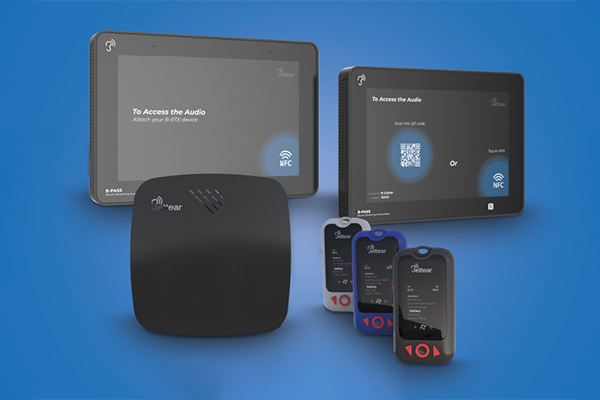
It’s clear that Auracast is one of the biggest growth areas for integrators across the world. Myke Ireland got his hands on a complete solution from Bettear to see how it all works.
Assistive listening has always been one of the hardest technologies to standardise in the AV market, with every new format bringing its own array of compromises. Magnetic induction loops ticked the BCA and NSDS compliance boxes, but failed the second a carpet layer cut your foil tape. IR systems demanded a clear line-of-sight, while FM systems are constantly threatened by spectrum changes. Early Bluetooth was crippled by a strict one-to-one limitation and WiFi simply traded AV problems for IT networking headaches.
ADVERTISEMENT
Enter Bluetooth 5 and the Auracast standard, which finally breaks that stubborn one-to-one limitation, delivering true one-to-many broadcasting without the nightmare of pairing menus or choked bandwidth.
Which brings us to today. I’m getting hands-on with the Bettear system, specifically a combination of the Caster, the B-Pass and the RTX operating as a unified kit. Purpose-built for assistive listening, broadcast audio, museum tours, visitor centres and tour guide applications, let’s look at how Bettear deliver on the promise of Auracast.
Out of the box
Because this ecosystem tackles a multi-layered problem, viewing it as a single “product” doesn’t quite do it justice. To understand how it operates on a venue floor, you have to look at the three distinct pieces of hardware doing the heavy lifting.
The Caster: The brains of the operation. This primary transmitter takes your venue’s audio feed and broadcasts it over the Auracast network. Physically, it mimics a standard wireless access point. Mount it to a ceiling or wall alongside your existing WiFi, and it completely blends into the background.
Crucially, it pushes audio with a sub-40ms latency, a standout number in the AV world. Whether someone is watching a live presenter or a commercial display, the audio stays tightly lip-synced and is a massive improvement over the lag we typically see with WiFi systems.
The B-Pass: This is the physical bridge between the network and the end-user. Essentially, a smart, NFC-enabled display panel mounted to a wall or desk, its primary purpose is to kill the traditional Bluetooth/WiFi pairing nightmare.
Instead of forcing users to scroll through messy Bluetooth lists, guessing which stream belongs to their room, the B-Pass makes connecting a physical action. Tap the receiver against the panel, and the audio synchronises instantly. It also hosts a QR code for app-based Auracast receivers.
The RTX: This is the hardware the user actually carries. It’s a palm-sized, lightweight unit designed for a lanyard, featuring a crisp LED display to show the active feed and large, tactile buttons to manually switch streams. Post active shift, they recharge individually via USB-C or drop into a dedicated rack-and-stack dock.
A unique feature of the RTX, and Bettear’s approach more broadly, is its split personalities. Separating it from a standard “dumb” receiver, it is actually a transceiver in the true sense of the word. Yes, it delivers pristine 48kHz, 24-bit audio to headphones or a magnetic neck loop, but plug a laptop into its USB-C port, and it captures and streams local audio back to the Auracast network. It’s a remarkably intelligent way to enable ad-hoc services like real-time translation, and a brilliant way to overcome the anxiety of committing to a fixed input channel count with traditional systems.
Management and control: Two ways to play
Hardware is only ever half the battle. If backend management is a nightmare, the system eventually gets ignored by staff and is retired early. Bettear appreciates this, splitting their software into two distinct tiers based on scale.
For single-room or set-and-forget setups, everything lives directly on the Caster. Hitting its local IP opens a clean web dashboard covering the essentials: Adjusting input gains, naming broadcast streams, and locking down network settings. It’s fast, uncomplicated and doesn’t require a dedicated server.
However, for large deployments like convention centres or university campuses, you step up to Hive Central. This enterprise platform is where the system flexes its muscles for fleet deployment. From a single interface, AV managers get global control to monitor battery levels across docked RTX receivers, push firmware updates, and dynamically assign audio streams.
It also handles complex zoning and multi-language configurations. Operators can build the user experience in advance, ensuring an attendee’s unit is pre-locked to the correct feed, removing front-of-house guesswork and keeping reliable control firmly back-of-house.
In Use: The User and The Abuser
For the person actually wearing the device, the experience is a dramatic uplift from the industry norm. In audio terms, we are entirely used to magnetic loops and IR systems that sound like a muffled AM radio on a good day. WiFi systems haven’t fared much better, often plagued by latency and dropouts to the point where users just give up and disconnect.
The Bettear system, frankly, is almost too easy to use. Under review, there wasn’t much for me to poke holes in. You plug in an audio source, turn on the RTX receiver, tap it against the B-Pass panel and you’re immediately locked onto the stream. End-to-end, it’s a sub-20-second process to boot up and start listening.
The real standout is the audio quality. As mentioned earlier, we are talking about near-CD quality. Yes, if you listen critically, you can hear a tiny bit of digital compression, but nobody is using an assistive listening pack to evaluate immersive, experiential audio. For the intended application, delivering clear, intelligible dialogue and localised sound, the fidelity supersedes almost anything we’ve historically had access to.
On the backend, managing the system is just as painless. The local GUI driving the Caster is completely unintimidating. It’s easy to navigate, and critically, it doesn’t overwhelm you with a million unnecessary menus.
As a first-time user, I found it incredibly simple to make base changes and tweak basic performance settings. While I didn’t get hands-on with the enterprise-level Hive Central software for this specific review, if the local hardware configuration is any indicator, it’s safe to assume that same straightforward usability simply scales up.
The wrap-up
Personally, I love a product that does what it says on the tin, and in the notoriously finicky world of assistive listening, that is usually the highest form of praise.
From an integration standpoint, the straightforward setup and configuration mean you aren’t going to be stuck sitting through a full day of vendor training just to get a basic audio feed up and running. It just works.
Then there is the operational reality. Because Auracast is built on the Bluetooth Low Energy standard, these RTX receivers will comfortably average eight hours of continuous listening. For a venue, that is massive. It means getting through a full day of open doors without having to frantically cycle dead units back to a charger. Inherently, this removes the old-school requirement of having to buy double the amount of receivers just to maintain a rotatable stock.
While I’d love the opportunity to explore the full, unbridled range of what Bettear has to offer on a massive enterprise scale with Hive Central, this local kit already sets a remarkably clear baseline for what to expect.
Looking ahead, with more and more big-name AV brands now adopting Auracast as their assistive listening protocol of choice, we can only expect cross-compatibility and system expandability to continue evolving over the next few years. But as it stands today, if competing manufacturers want to pitch an Auracast solution to the market, the Bettear ecosystem is the product to chase in that race.
So, let’s close out with those ever-appropriate song lyrics from The Who, You Bettear, You Bettear, You Bet.
Manufacturer: Bettear
Distributed by: Madison AV
-
ADVERTISEMENT
-
ADVERTISEMENT
-
ADVERTISEMENT
-
ADVERTISEMENT