
Beale Street Audio BAV4250
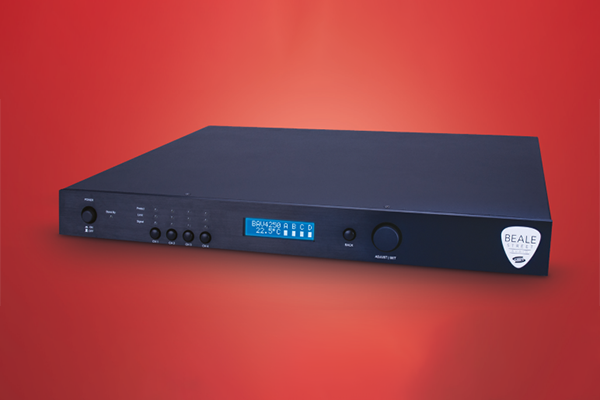
Vanco has released a 1,000W, four-channel amplifier via Beale Street Audio. Myke Ireland checks the unit out to see how it stacks up against its competitors.
Ahhh, Amplifiers… The unsung heroes of the AV world. Relegated to dark, humid AV racks, usually down in the bottom few RU slots, gathering dust, always on and often having to outlast every other piece of technology that rack will ever see. We don’t often give amplifiers much thought in the commercial world. A designer’s choice is most informed by adding up all the wattage in a 100V circuit and choosing the cheapest amp that offers what you need, plus an extra 10%. And that’s more or less it.
ADVERTISEMENT
Sonic quality is seldom ever a consideration unless, of course, it’s a proper front-of-house PA. For BGM, program audio and public address, it’s often a case of: “if you can hear it, it’s good enough.”
But is it? What if you want a space that sounds good? What if you want to run a mix of constant voltage with low impedance and keep the sonic characteristics of both outputs in line? There are a million reasons you want an amp that sounds good, the real challenge is finding one that matches the budget and doesn’t need to be paired with an additional $3,000 DSP.
But is there still room in the commercial market for amps that actually sound great? Well, Beale Street Audio seems to think so.
Out of the box
On face value, the BAV4250 is a single RU full-metal chassis that understands it’s going to spend a good portion of its life in that aforementioned low-down rack slot. It’s understated to look at and probably isn’t lining up for any industrial design awards, but it’s heavy and it’s built tough, two highly reassuring traits that usually indicate an amplifier is actually worth its salt.
On the front panel, you have channel select buttons under correlated LED indicators to arm a channel you’d like to perform an action on, while a round jog wheel allows you to move through parameters you want to select and adjust. Actions are confirmed by pressing down on the jog wheel, accompanied by a small back button to step out of any menu navigation. Feedback is displayed on a low-res backlit LCD display, which gives you the basics, but for any detailed configs, you want to take advantage of the built-in GUI. And finally, there is a big, juicy power button, which is good to see. Amps should never have soft-start touch controls; you want to feel a solid click and visually see the state of the button.
On the back are either four unbalanced RCA connectors or four balanced Euroblock connectors, one for each input and four Euroblock speaker outputs. There’s an RJ45 network port for management and to access the full DSP feature set remotely. The unit ships with factory rack ears, but they’re not part of the chassis itself, which is helpful in settings where there’s no 19” rack to take advantage of, or the consultant forgot to specify one.
When out of a rack, the unit has four built-in large rubber feet to place securely on a shelf or in a credenza. Given the BAV does have active internal cooling via two side fans, just keep that in mind if you’re installing in a quiet meeting room or functional space. Depending on how hard you’re pushing it, those fans do inevitably get a little noisy from time to time.
Inside the box
Do you remember the old Castrol advertisement from the 80s, the “oils ain’t oils” one? Well, it’s kind of the same with amplifiers in the modern age.
Whilst the purpose of a dedicated amplifier is to amplify audio after every other element in the signal path has done its job, some jobs just don’t require that full signal path. I’ve priced projects in the past where a DSP alone was 50% of the entire gig, and clients look at you as if you have two heads. Those jobs usually end up with no DSP, which, of course, the project commissioner loves to see.
The BAV4250 fits beautifully inside that little debate with one of its signature features: an onboard DSP.
The keyword here is practical. In 90% of the installed sound universe, Beale Street’s lightweight software stack is more than enough to get the job done. You don’t need to sit through a two-day training course just to do the basics, and the GUI is non-threatening enough that you could have junior techs out there flipping rooms on their own.
First up, you hit a four-by-four matrix configurable to any combination of ins and outs you might need. Following a logical signal path, the GUI nicely separates your processing on the input side. You get input level control and individual channel mutes, real-time in and out level meters, dedicated treble and bass controls and independent high-pass filters for clinical tidy up your incoming audio.
From there, the heavy lifting shifts to the output stage, where the DSP lets you go all-out studio, applying a dedicated three-band parametric EQ to each individual output. From a simple dropdown menu, you can select the exact filter type you need, deploying these as peak, notch, low-pass, high-pass or shelving EQs, which gives you that extra saucy control over frequency and bandwidth exactly where the speakers need it. Audibly, the filters are clean, precise, and still leave some natural sonic character in the final result.
Lastly, to keep everything safe, each channel has an active clip limiter that responds to any rogue amplitude, automatically compensating for load variations while giving you visual feedback in the GUI so you know exactly when it’s stepping in to save the day.
So, how does it sound?
If you spend enough time reading spec sheets for commercial audio gear, you start to realise that the industry has a very specific scorecard for success. For the vast majority of commercial amplifiers on the market, that scorecard is simple: cost versus output. How many watts can we cram into a single RU chassis, and how cheaply can we get them there?
That is exactly where the BAV4250 separates itself from the pack. Unlike the utilitarian, “watts-per-dollar” boxes that flood the commercial market, this is a genuinely good-sounding piece of hardware. When you actually put it on a test bench or load it up with a heavy 70V or 100V daisy-chain, it doesn’t lose its composure or dramatically roll off the low end like cheaper amps often do. It maintains an impressive dynamic range and a rich, articulate clarity that you would normally expect from a dedicated residential hi-fi setup.
Because in fact, the BAV is both a residential and a commercial amplifier, depending entirely on how you choose to use it. By supporting both constant voltage and low impedance outputs across every single channel, the unit can shape-shift to meet a variety of demands. My brain goes straight to a university classroom where I might have some low impedance front-of-house speakers and some 70V ceiling speakers that I need to weave together. Or, on the residential side, having the exact same unit looking after some banging black boxes in your listening room while simultaneously managing the outdoor audio across the courtyard with no compromise between your 8Ω and 70V paths.
The wrap
In the interest of calling an amplifier a spade, a price point north of A$2,000 means the BAV4250 isn’t the cheapest amplifier you can pull off a distributor’s shelf. But if you’ve been doing this long enough, you know how to do the integrator math.
If you were to spec a standard, dumb commercial amp and then try to fix the sound by adding an entry-level standalone DSP, that processor alone will usually set you back well over $1,500. Not to mention, it will inevitably come loaded with a significant number of bloated features and menus that you will never actually use for a typical commercial or resi-blend install.
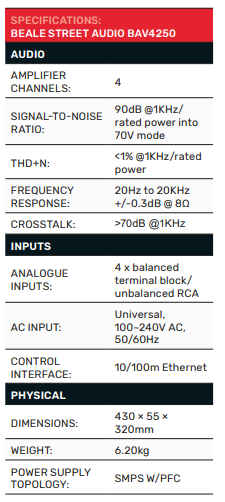
When you consider that the BAV4250 is handing you four channels of 250W audio, highly practical DSP across every single one of those channels, network management and control, plus the ability to save and recall presets for any combination of settings you choose, the math suddenly looks very different. It firmly places itself in a very high value-for-money bracket, delivering all that functionality with virtually no sacrifice to sonic depth, accuracy or overall listening quality.
At the end of the day, if you believe your ears deserve a little bit more than just raw SPL, Beale Street may, in fact, be the road you need to take a cruise down.
Manufacturer: Vanco
Distributed by: Audio Connection
-
ADVERTISEMENT
-
ADVERTISEMENT
-
ADVERTISEMENT
-
ADVERTISEMENT