
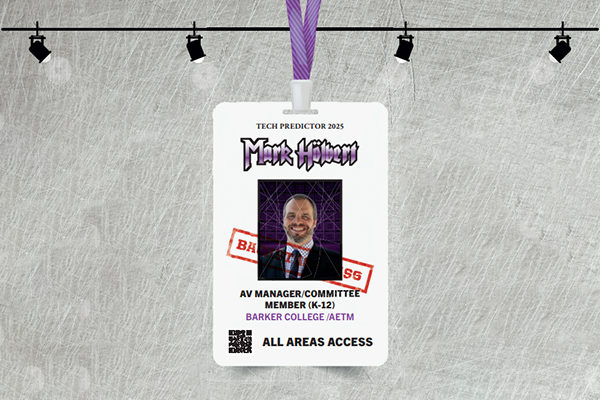
2025 Connected Tech Predictor | Mark Holbert
- Hybrid teaching will become more widespread
Hybrid and “hyflex” classrooms, once a pandemic workaround, are now standard in most universities and growing across K–12. Students value flexibility, while educators appreciate the ability to record and reuse content, and it’s a trend that’s here to stay.
Teaching spaces with automatic camera tracking, simple user interfaces and cloud-based recording are commonplace in universities. Hybrid meetings are becoming more seamless as an at-home attendee can speak to an in-person student clearly through the technology now available.
ADVERTISEMENT
As this technology becomes more affordable and easier to manage, expect K-12 schools to begin moving towards this room type as a standard.
- AV-over-IP continues taking steps
AV-over-IP is transforming how institutions design, deploy and manage systems. It offers scalability, redundancy and central control that analogue and HDMI matrix systems can’t match.
As AV and IT continue to converge, the relationship between campus network teams and AV managers will become even more critical. Expect clearer governance on VLANs, QoS and cybersecurity as AV traffic leverages even more of the main network.
- Audio quality takes centre stage
In recent years, it seems that most of the evolution of AV equipment has been on the video side of things, focused on displays and cameras. I would suggest that institutions are rediscovering that audio is what makes learning intelligible.
Beamforming ceiling microphones, adaptive DSP and distributed audio systems are increasingly becoming standard. Educators and AV professionals are realising what a critical role audio quality plays in educational outcomes.
Expect more and more designers to have audio quality as their primary concern when approaching a project.
- Increased adoption of LED by schools and universities
Falling panel costs and simplified installation are bringing LED walls within reach of smaller universities and K–12 schools. In recent years, we’ve seen a few case studies of educational institutions getting their hands on LED technology and finding excellent uses for it.
Building on the falling outlay, the overall spend is coming down as well, with lower operational costs. The industry is also seeing higher energy efficiency and longer lifespan, reducing the total cost of ownership compared with a projector, for example.
Fine-pitch and modular designs, along with new technologies like MIP LED, allow tailored brightness and pixel density for classrooms, halls and outdoor signage. Building on that design flexibility, curved, ultra-wide and interactive LED formats enable creative learning environments beyond flat projection screens.
- The AV workforce
The issue that we’ve been talking about for decades… the AV industry workforce. And more importantly, how do we find new employees? I believe that the AV industry will continue its push to attract more young people to the AV industry, through increasing numbers of graduate programs, cadetships and industry taskforces.
Also, the shift toward networked, software-defined AV systems is exposing a skills gap. Technicians who once focused on cabling and control are now expected to manage VLANs, firmware and API integrations.
According to Midwich’s Michael Broadbent in his 2025 AETM K-12 conference session: “We’re not just hiring AV techs anymore, we’re hiring AV network engineers.”
-
ADVERTISEMENT
-
ADVERTISEMENT
-
ADVERTISEMENT
-
ADVERTISEMENT