
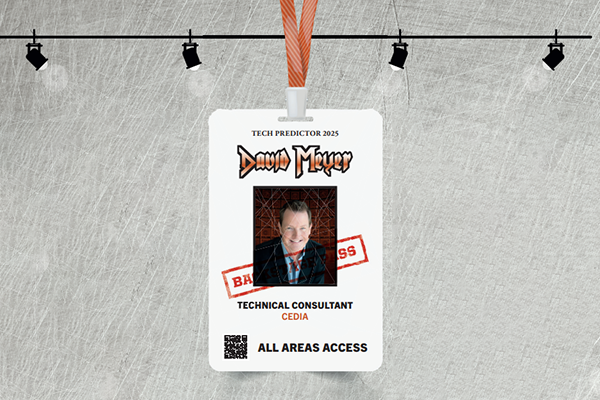
2025 Connected Tech Predictor | David Meyer
- AI is edging closer to actual intelligence
Yeah, I know, including AI in this list is hardly a tech prediction in its obviousness. On the flipside, it underpins so much of what’s happening now that I can’t not include it.
When product marketers latched onto AI several years ago, I somewhat facetiously described the acronym at the time as meaning “automatic implementation”. Yep, a flash new term for the good old auto mode.
ADVERTISEMENT
However, today’s AI is mostly “aggregating information”, or an optimist might describe it as “augmenting intelligence”. In any case, we’re marching ever closer to AI becoming “actual intelligence”. Give it 1,000-plus qubits of quantum computing power (it’s already a thing) and the mind boggles about what’s down the track.
By the way, I wrote this entirely myself. Old-school, right?
- The smart home evolves into the intelligent home
“Smart” anything generally just means internet-connected and remotely controllable. Smart home is a broad term that CEDIA has homed in on to succinctly describe our industry.
But wait, there’s more. With AI developing so quickly, this will expand and evolve to intelligent homes in which the systems make decisions for their occupants, where UI interactions reduce in favour of intuitive, unprompted responses.
That won’t diminish the role of integrators and control systems. Quite the opposite: The opportunities and scope for deeper integrations and even better, seamless user experiences will only grow.
- Early adopters paying to beta test big tech
Emerging technologies are increasingly relying on big data to work well, and crowdsourcing that data after product launch is already happening.
For example, some EV owners have already paid a premium for autonomous driving capabilities, but the cars themselves are effectively on L-plates and contributing to the global pool of self-drive training data with each outing.
Perhaps a more concerning example is coming with humanoid assistance robots in the home, with some slating the rollout as early as 2026. The training requirements in home environments will be huge, maybe even needing remote-piloted trainers to get them going with some tasks.
Securing home networks and their many connected cameras, microphones and sensors have long been core for integrators, but giving those connected cameras, etc., the ability to walk around a home takes it to another level. Again, loads of opportunity.
- The rise of healthier lighting
I’ve written several articles, white papers and trainings about human-centric lighting, so admittedly, I’m probably a little biased, or at the very least, hopeful. Turns out the typical LED lights used in most homes aren’t good for us, made to balance price and lumen output.
Therein lies a massive opportunity for integrators to inform home owners about higher-quality, healthier options. It’s one of the simplest and most beneficial upgrades that can be made to any home.
At its most basic, just swapping out existing lights for high-CRI, low-flicker alternatives can provide great benefits. Better still, upgrading to tunable circadian lighting with an appropriate control system isn’t just nice to have, it really does improve health, wellbeing and productivity. It’s win-win. Check it out.
- Qualifying the future
Our industry has long struggled with a lack of formal recognition. Ongoing challenges include finding qualified staff or even getting the right business insurance. 2026 will be an important year in developing a formal integrated systems apprenticeship pathway in Australia… a world first.
We’re also due for a national census in 2026, so if you’re an integrator, please be sure to have all your staff, regardless of role, declare their occupation as ‘Smart Home Technology Integrator’. That’ll be an important first step to formal industry recognition, with the apprenticeship following right behind.
-
ADVERTISEMENT
-
ADVERTISEMENT
-
ADVERTISEMENT
-
ADVERTISEMENT