
Watts up with PoE?

Every integrator is familiar with PoE technology, but there are several key areas that still befuddle the most experienced installer. David Meyer dives deep into the subject.
Power-over-Ethernet (PoE) is a technology that many integrators implement regularly and probably take for granted. It’s been around for over 20 years with an accumulated install base in the hundreds of millions, if not billions, of ports worldwide. It’s plug-and-play. It simply works. It’s brilliant. But that doesn’t mean people can’t still get confused about it.
ADVERTISEMENT
I attended an industry meeting recently in which someone raised concerns that handling PoE in Australia might require electrical licensing in future. This notion crops up from time to time. My first thought was that they might have been concerned about regulatory authorities moving the goalposts, which I guess is possible and has happened in some jurisdictions. For example, the US state of Massachusetts has gone well beyond the US National Electrical Code (NEC) by introducing licensing requirements for all low-voltage cabling, overseen by the electrical licensing board. It’s not insurmountable, but it is certainly a regulatory burden for integrators.
However, in the case of the local concern, I think it was actually somebody simply confusing watts for volts, wherein a rumoured 200W version of PoE would exceed the 120VDC cap for extra-low voltage (ELV). But of course, they’re different values.
It would be like getting a speeding ticket for driving a 200kW car in a 100km/h zone. I don’t know for sure if it was that simplistic, but there was certainly a misunderstanding about something. For the record, there’s no sign of regulations changing locally. The AS/NZS 3000 definition of ELV remains unchanged and consistent with the IEC 61140 international standard at 120V ripple-free DC.
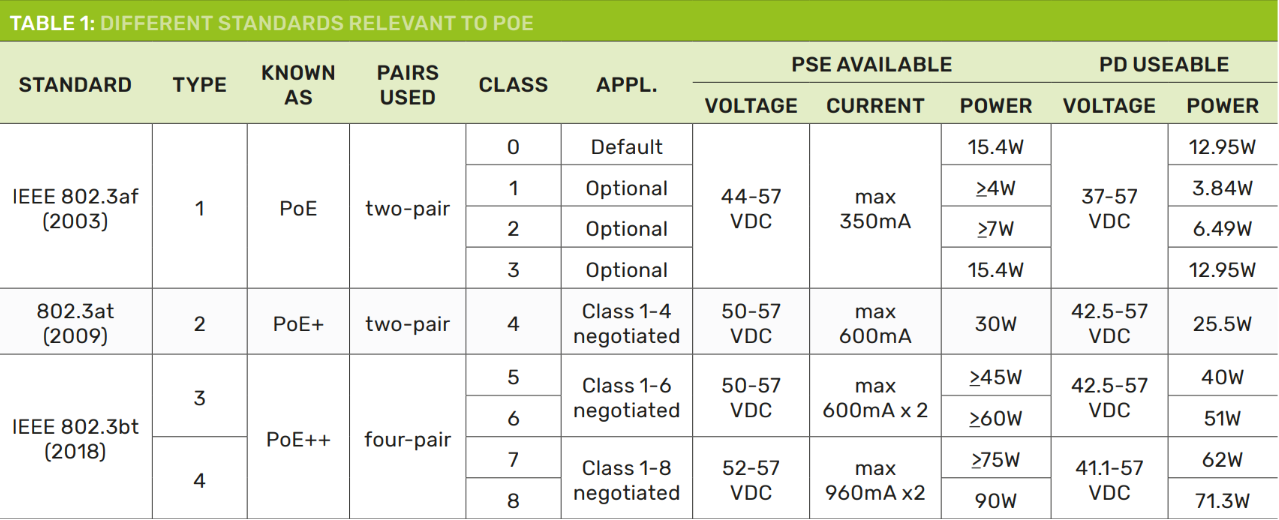
In defence of the misunderstood, PoE is subject to three different standards, four types, two negotiation methods and eight power classes. It’s little wonder some find it baffling once you dig into it. Just as well, it’s plug-and-play technology, so integrators typically need only worry about getting the right specification products, using the right ports and ensuring integrity in the cabling.
But I’ve often remarked that installation integrity relies on knowing what a system is supposed to do, so you can know when it is or isn’t doing it properly. To that end, I want to cover three key things about PoE in an effort to demystify any confusion: 1. PoE standards, 2. PoE basics and 3. PoE safety and installation best practices.
PoE Standards
Networking standards are defined by the IEEE, and there are a lot of them that all interoperate seamlessly. There’s IEEE 802.1 that describes local area network (LAN) architecture and management, while 802.11 defines wireless networking. Then there’s 802.3 that defines what goes through the physical layer, things like data packaging and speeds, protocols and PoE.
If you’re even half as geeky as me, you’ll probably find a browse through the huge library of 802.3 docs quite insightful. There are over a hundred documents providing a history lesson in the evolution of networking.
They started with 802.3a back in 1985, which defined 10Mb/s data over a thick coax cable. As each new release came out it was assigned the next letter — 802.3b, c, d, etc. When they ran out of single letters they went to double — 802.3ab, ac, and so on. Now in 2026 the latest standard they’re working on is IEEE 802.3du, so they’re not going to run out of letters anytime soon!
Among these documents are three that define generations of PoE:
- 3af in 2003, later referred to as PoE Type 1
- 3at in 2009, Type 2, called PoE+ to distinguish it from original PoE
- 3bt in 2018, Types 3 & 4, PoE++
All three remain current and backwards compatible.
PoE Basics
There are two different types of PoE devices. Knowing the distinction is fundamental to understanding PoE:
- Power Sourcing Equipment (PSE): Any device that provides insertion of power into the network. Namely, a PoE switch or PoE injector.
- Powered Device (PD): Any device that draws its operating power through the network port instead of from an external power supply. Common examples include wireless access points (APs) and IP cameras.
Once connected, PSE doesn’t just randomly open a voltage tap on a network link for fear of damaging a connected device that’s not PoE compatible. Things will start smoking if you do that. But also consider that a PD initially has no power from which to assert its presence, so how does a PSE know when to send power, and how much? Well, this is how it works:
- The PSE starts by putting very low, harmless voltage pulses on the link (<10VDC). An incompatible device will safely ignore it, but if it’s a PD needing power, it will present a pre-determined, specific level of resistance on the wires that acts as a PoE signature.
- Once this signature resistance is detected by the PSE, it then ramps up the voltage just enough (around 14-20VDC) to enable handshake. There are two different ways a PD can let the PSE know how much power it needs:
- Hardware handshake — the PD draws a specific amount of current that serves as a “class signature” to signify which class of power to use.
- Software handshake (Type 2-4 only) — a more sophisticated process using the Link Layer Discovery Protocol (LLDP) to negotiate which Class to use (1-4 if Type 2, Class 1-8 if Type 3/4). It can even nominate in-between levels in 100mA steps.
- Once the PSE and PD have established a common level of supported power, the PSE can go ahead and supply the agreed operating power to the PD.
To use an automotive analogy, step one is akin to using a coded remote to unlock the car, step two is activating the car’s electronics in preparation for ignition and step three is starting the motor and driving.
PoE safety and installation best practices
In case you ever wondered where the various power level figures come from, they’re basic Ohm’s law:
V x A = W
Using default PoE (Class 0) as an example, referring to the top row of the table, the minimum voltage is 44V and the maximum current is 350mA (0.35A):
44 x 0.35 = 15.4W at PSE
DC voltage will always drop to some degree over a length of wire. How much it drops depends on the properties of the wire and its length. So, according to the PoE standard, the 44V mentioned above can drop by as much as 7V by the time it arrives at the PD, leaving as little as 37VDC:
37 x 0.35 = 12.95W at PD
In practice, a PSE is likely to start at a higher voltage, like 48-52V, so less current will be drawn to start with. Also, the cable may not be anywhere near the 100m maximum, so the voltage drop will likely be a lot less.
The next point is an important one, so I hope you’re still with me!
The power lost over a cable doesn’t just disappear; it converts to heat. That can require some management to ensure it doesn’t create a fire risk or hinder data performance.
Single cable runs and small bundles are generally of little risk, dissipating heat effectively enough. However, if a large bundle has many cables running higher levels of PoE and the heat can’t dissipate, the heat of neighbouring cables compounds to result in thermal buildup from the inside out.
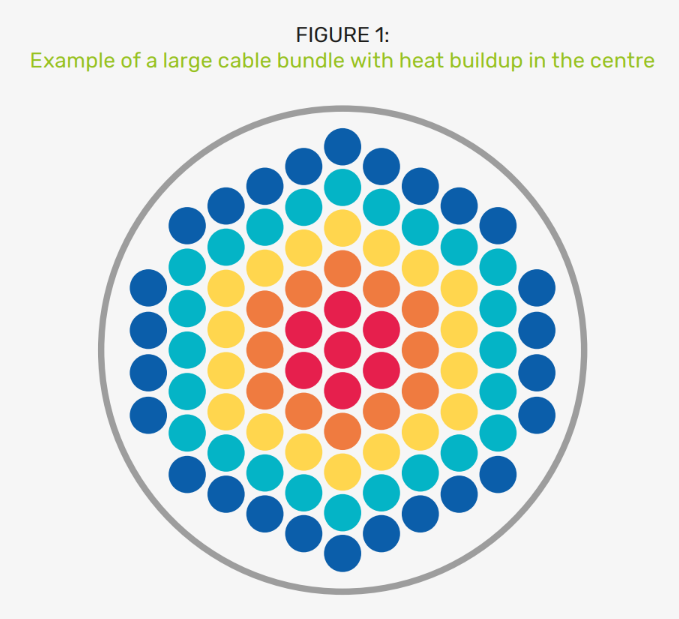
Figure 1 Example of a large cable bundle with heat buildup in the centre
Underwriters Laboratories (UL) in the US has long been performing tests on PoE with cable bundling. What really impresses me the most about their work is that they test for data performance alongside PoE in certain thermal conditions. After all, it’s no good saying a cable is good because it doesn’t catch fire, but it fails to pass data anymore. We want low heat and full data performance, thank you very much!
Installation tips:
- Ensure the infrastructure network cabling comprises pure copper cores, not copper-clad aluminium (CCA) or similar. Aluminium is around 60% more resistive than copper, meaning it would cause much higher power loss, translating to more heat and lower overall performance. Avoid it for PoE.
- Solid vs stranded cable won’t affect PoE performance. However, thickness (gauge, AWG) does matter. Speak to your supplier about PoE suitability. Smaller gauge, like 28AWG, might be fine for shorter runs (<40m or so), but the regular 24AWG would be essential for longer lengths to minimise voltage drop.
- Ensure any PSE you’re specifying, such as a PoE managed switch, supports the maximum PoE Type that you want to use, and that you employ the right ports for the respective devices. This seems obvious, sorry.
- Another obvious one: Ose only high-quality cables that will permanently maintain their geometry even under some degree of thermal stress. If you need to bundle cables, use a few smaller bundles instead of one large one.
- Power-over-HDBaseT (PoH) is based on PoE, essentially using the same PSE and PD modules built into HDBaseT products. Similar recommendations apply.
- In the last issue of this mag, I talked a bit about Power over Data Lines (PoDL), which is similar to PoE but specific to single pair Ethernet (SPE). Watch this space.
In closing, I’ll double back to the earlier mention of PoE, maybe going to 200W. Personally, I don’t think it will. Technically, it could, but in the US, PoE is considered a Class 2 circuit and limited to 100W. I can’t see 200W being introduced if it’s not allowed in the US. Time will tell.
-
ADVERTISEMENT
-
ADVERTISEMENT
-
ADVERTISEMENT
-
ADVERTISEMENT