
The next step in smart home technology for disability living
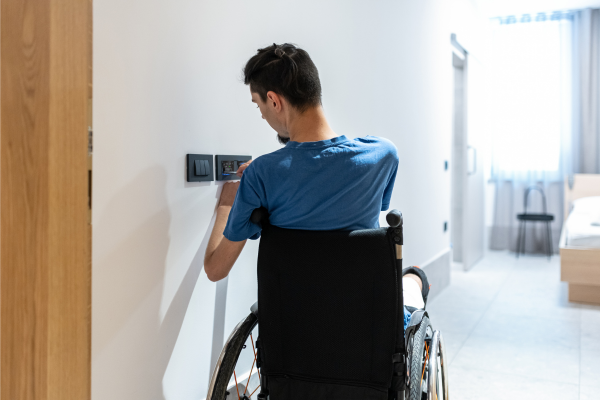
There’s a huge opportunity to improve the lives of those living with a disability through smart home technology. Sean Carroll explores the next step in this journey, finding the solutions that work for the people actually using it.
At the 2025 CEDIA Tech Summit, occupational therapist (OT) and University of Sunshine Coast (UniSC) associate professor, Michele Verdonck, spoke to the attendees about smart home technology and its ability to assist those living with a disability.
ADVERTISEMENT
She opened her presentation by explaining an early situation where a young man with a cognitive disability was stuck at home watching reruns of Home & Away because he couldn’t properly access the controls. She says it’s her goal to ensure nobody gets stuck in a situation like this where the technology isn’t suitable for a person’s living situation (and, tongue in cheek, that nobody gets stuck watching Home & Away).
While the benefits are clear for this space, namely voice control, sensors and automation, there is a disconnect between the installers and the users. Almost every single use case in these types of installations is different. There’s no one-size-fits-all solution when it comes to smart home and AV. Because of this, Michele attended the CEDIA Tech Summit to gather richer information about the installer side and find out what can be done to get more integrators working in the disability space.
Home automation technology can give someone with a spinal cord injury the ability to answer their front door, adjust their environment, control entertainment systems, communicate with carers and live more independently. For someone with limited mobility, these aren’t luxury conveniences. They’re life-changing capabilities.
The technology already exists and, in many cases, it’s affordable. So why isn’t it already being used? The answer is: it is. But it’s extremely complicated. It involves funding models, education gaps, industry silos, inconsistent standards and a simple reality that many technology systems designed for convenience aren’t robust enough when someone’s independence depends on them.
“There’s no cookie-cutter solution for this space as disability is incredibly varied,” Michele explains.
“Understanding neurodiversity is different from understanding a spinal cord injury. Integrators aren’t disability experts and OTs aren’t tech engineers. That’s why this collaboration matters.”
An OT by background, she spent years working with people living with spinal cord injuries and severe physical disabilities. Through her clinical work, she witnessed how even relatively simple technologies could dramatically improve quality of life.
“I became very interested in people who were significantly physically disabled and essentially stuck without being able to do much independently. Technology offered them options,” she says.
Her early research focused on wired environmental control systems such as X10, a platform that now appears antiquated compared to modern smart home solutions. Michele says that with the rise of smart home technology it’s an exciting time to be working in this space.
CEDIA regional development independent consultant, Australia and New Zealand, Paul Skelton, says the residential smart home association is dedicated to helping more people living with disabilities gain access to these solutions.
“The relationship between integrators and OTs is central to this working and I would go so far as to say the best outcomes in this sector are impossible without it,” he says.
“When collaboration between an OT and an integrator works, the technology is prescribed against a real functional need, rather than guesswork, and it’s installed by someone who is accountable for it actually working. When it doesn’t – when technology is specified with no clinical input, or an OT’s recommendation is handed to someone without the competence to deliver it – you get the failures we have all seen.”
After securing funding from the National Injury Insurance Scheme Queensland (NIISQ), Michele is now researching the benefits of this kind of technology, the space integrators are working in, on people with traumatic brain injuries, spinal cord injuries or amputations, most of them coming from motor vehicle accidents.
“Since then, we have interviewed 13 people with these kinds of disabilities who use smart home technology. We’re identifying principles emerging from their lived experiences,” Michele explains.
“Redundancy is essential. You can’t rely on only one device to perform a single function. If something fails, there must be a backup.”
One of the goals of Michele’s research is to identify guiding principles that can help future integrators design these kinds of solutions. It’s clear from the outset that this is preferable to just prescribing specific products or devices.
So far, the key questions the study is asking about different products are:
- Is the system upgradable?
- Is it customisable?
- Can you build in redundancy?
Michele and her team have identified two broad approaches to this space. The first are ad hoc systems that evolve over time, with people adding to them gradually.
“One person I’ve spoken to still keeps old PDAs and sip-and-puff switches around, even though they have a full Fibaro system in their home. They just simply don’t trust the new system without an understandable, reliable backup,” she says.
“We also see plenty of people using several of the big control platforms – Google, Amazon, Siri – to ensure redundancy. One participant uses voice control on these platforms but always keeps a mouth stick and phone nearby as backups.”
Another participant has a full custom solution that “just works” despite having multiple different products from different manufacturers and no overarching control platform tying it all together.
“That’s why I’m passionate about working with integrators. When systems are designed properly from the outset, with hardwiring, backup power and strong network infrastructure, the outcome can be seamless,” Michele concludes.
Disability Services Consulting (DSC) principal consultant Brent Woolgar works with a range of disability accommodations in the National Disability Insurance Scheme (NDIS) home and living jurisdiction, and he’s amazed by what assistive technology has been able to do for recipients.
He tells the story of his son, an NDIS recipient, who was interested in using smart home technology in his day-to-day life before a consultant told him that his best bet was to move into a place that already had technology installed, or pay something close to $60,000 to install a proprietary system.
Since his son wasn’t eligible for Specialist Disability Accommodation (SDA) funding, something only about 6% of the NDIS cohort are eligible for, Brent and his son turned to off-the-shelf solutions, which were able to deliver a high level of automation for a fraction of the cost.
“The experience of going through that process generated the birth of OTShelf, a social enterprise that’s focused on using home automation to help fill the niche of NDIS participants who can benefit from using smart home technology but don’t have access to SDA funding,” Brent explains.
“We had a classic example with OTShelf where a young man was paying a support worker for three hours a day (the legal minimum shift) to meet him at the front door, help him get inside, turn the lights on and control the climate. After the start, the support worker had very little to do for the remainder of the shift. We introduced him to a few automation technologies and all of a sudden, the worker wasn’t needed, and that individual was able to save about $45,000 a year.”
While off-the-shelf assistive technology has seen success in these settings, the vast majority of cases don’t. That’s why it’s important to go through an integrator, a specialist in this field who understands the technology at a deeper level.
Livigy Australia and New Zealand is an integration company that provides smart assistive technology for individuals living with disabilities and the elderly. The company’s founder and chief executive, Matt Manalis, has been working in this space for over a decade and has seen his fair share of what goes into an appropriate smart home installation for this space.
“Over ten years ago, we started getting calls from OTs asking about smart home technology and how it can help improve the lives of those living with a disability. So, we did a roadshow across the country and spoke with OTs to understand what was missing and how we could help,” Matt explains.
He says that most of the work he completed early on was funded through state-based schemes and insurance bodies. At the time, funding was one of the biggest hurdles to getting integrators working in this area.
“We realised that there was a real opportunity here to provide solutions and improve the lives of those using them, but it needed its own identity and approach,” he says.
“We didn’t want people living with disabilities looking at high-end residential automation marketing and vice versa. So we launched Livigy. About 12 months later, the NDIS came in, and that completely changed the landscape. It opened access to far more people, and enquiries increased significantly.”
He adds that funding was one thing, but Livigy understood that the process was heavily focused on education, both for OTs and integrators. Because of this, all of Livigy’s work comes through OTs, meaning that they don’t sell directly to individuals unless it has been prescribed by an OT.
“I think this almost must be a regulatory requirement. Integrators aren’t trained to understand disabilities in the way OTs are. What often happens is that an integrator gets a call from a family member or care team and tries to deliver a solution by selling as much as possible to meet perceived needs,” Matt outlines.
“The problem is, we don’t have the clinical understanding. We don’t know how someone’s disability might evolve, whether they might lose mobility or speech, or how their needs might change over time. OTs, on the other hand, study for years to specialise. They also tend to have long-term relationships with the people they’re supporting.”
Paul says that CEDIA is actively advocating for the adoption of its recommendations by government agencies to further magnify the positive impact on the lives of those with living with a disability.
“Regrettably, there have been instances of unethical practices, such as installing inadequate systems at exorbitant costs. These incidents underscore the crucial need for industry oversight,” he says.
“Through active engagement in the disability sector, CEDIA aims to advocate for accessibility, eradicate unscrupulous behaviour and emphasise the indispensable role of smart home technology as a necessity, not a luxury.”
Paul mentions one example of egregious price gouging to which he was alerted: an electrician installed a voice assistant and a smart speaker, claiming it was a fully integrated nurse call system and intercom, and then invoiced the client for $20,000.
Thankfully, these installations are in the minority, and integrators like Matt from Livigy are doing the right thing: “Our job as integrators is to find the best way forward with the least long-term cost. The NDIS isn’t an unlimited pool of money. Funding might be available now, but not in the future, so we need to design systems that meet the current needs and can adapt over time without needing to be ripped out and replaced.”
Moving forward, Michele says that she’d like to see a clearer accreditation system, perhaps even self-accreditation: “This would so that the integrators out there who are genuinely interested and understand disability-specific needs can differentiate themselves from their competitors.
“At the same time, I’m hoping to educate OTs so they can better understand the role of the integrator and how they can help.”
CEDIA and UniSC have received a small grant to conduct a pilot study with integrators. Michele is currently seeking integrators who are interested in being interviewed.
In Australia, CEDIA’s focus is on building the foundations laid through its lobbying work on the SDA Design Standard, where industry volunteers developed a set of recommendations for applying smart home technology well in this context.
Paul says the priorities now fall into two areas: “First, advocacy. The current NDIS reform period is precisely the moment for our industry’s voice to be heard, to argue that assistive technology, and the people who install it, should be held to recognised standards and that competence and accountability belong at the centre of how these systems are funded and delivered.
“Second, education. We remain committed to equipping integrators with the specific knowledge this work demands, which differs in important ways from conventional residential projects. This will be reflected in the forthcoming apprenticeship program.”
Matt Manalis agrees, saying that the industry needs clear guidelines, even formal standards, to help set expectations across the board: “Without them, it puts a lot of responsibility on the people doing the installations to act ethically and make the right calls.
“We also need more support from manufacturers, particularly around accessibility. A lot of control apps still don’t properly integrate with built-in accessibility features on devices like iPhones. That forces us to build custom interfaces, which adds complexity and cost.”
He concludes by saying it’s similar to the work integrators have been doing in the residential space: educating home owners about what’s possible. Now the industry needs to do the same with the disability sector.
It feels as though the smart home and AV industry is right on the precipice of something incredible with these kinds of jobs. But it’s no time to relax. The research by UniSC, in partnership with CEDIA, is a huge step forward for the industry because, as long as there aren’t regulations or guidelines set in place, the industry is susceptible to cowboys.
If assistive technology isn’t being installed thoughtfully and with purpose, it’s as useless as if it’s not there. And if there’s a chance that someone’s still sitting in their home, forced to watch reruns of Home & Away because there wasn’t redundancy built into a system or the control doesn’t work 100% of the time, then the industry is back to square one.
-
ADVERTISEMENT
-
ADVERTISEMENT
-
ADVERTISEMENT
-
ADVERTISEMENT