
The march towards “ens***ification” (and how to apply the brakes)
Technology is taking away from personal connections and potentially hurting overall experiences. Geoff Meads explores what can be done to reverse this trend.
I admit it, the title of this article is deliberately worded to attract attention. I didn’t invent the term “enshitification”, but I do think the need for its creation is something we need to examine.
ADVERTISEMENT
The initial impetus for the word came about a few years ago to describe the deliberate launch of a business with a product that has lots of features, only to remove or dilute those features later. In some cases, the features are reintroduced for additional fees or simply removed altogether to lower the business’s costs. In the old days, we called it the bait and switch.
Health insurance awards
A good example is the health insurance package I currently have. It’s based on tracking your exercise and rewarding you the more exercise you do. For health insurance, this makes sense. The more you exercise, the healthier you are likely to be and the less likely you are to make a claim. At least, that’s the theory.
In the beginning, the rewards were great! One benefit was a free cinema ticket every week for a certain level of activity and a scaled cash-back reward at the end of the year was another. But, as you might guess, the once free cinema ticket per week soon became a 50% discount, and the activity needed for each yearly cash-back level got larger and larger.
Although I could probably have predicted such moves, it still leaves a bitter taste in the mouth of the customer. A taste which is seldom forgotten, but often shared.
Heated seats subscriptions
A more tech-related example is the ‘heated seat subscription’ debacle offered by BMW. Yes, if you didn’t know about this already, in July 2022, BMW offered their heated seats feature (one that was already installed in all applicable cars) as a subscription add-on. Hardware that buyers had already paid for in the retail price was only actually usable if you coughed up £15 per month for the privilege.
As I write this now, it seems unbelievable, but it actually happened. As you can imagine, the backlash was huge. The national press ran inflammatory stories and customers were up in arms. So much so that BMW pulled this business model a year later.
As an example of enshitification, this one is hard to beat. A feature that is fitted if you pay a subscription but removed if not is one thing, although I do believe many buyers are now suffering increasing subscription fatigue. But a feature you have already paid for that is then subject to further and repeated charges is simply extortion.
Conversation killing cash registers
While the heated seat example is financial trickery, my next example involves marketing stupidity.
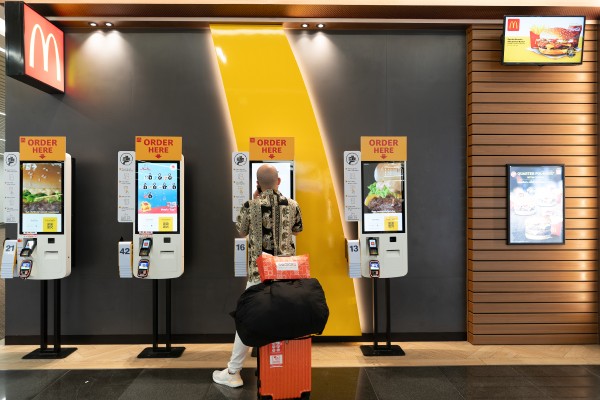
An increasing trend in food and drink outlets is touchscreen ordering. You see them everywhere. The world’s largest burger outlet was among the first to introduce them in 2015 (you know the one, it begins with an ‘M’). The idea is that making customers use touchscreens to order food saves costs as fewer staff are needed to take orders. In addition, it ties in with their app for rewards and the ability to order ahead.
While you can see advantages from the restaurant chain’s point of view (and this business is far larger than anything our industry has, so cost savings must be huge), the technology deployed dramatically reduces person-to-person contact, and that, in sales terms, can be a huge missed opportunity.
One of the first things you hear when you study sales or marketing is the phrase “people buy people”. After years of working in this field, I can 100% confirm that’s true. Removing humans from the sales process is pretty much always a bad idea when it comes to the volume of sales. For example, a human politely asking: “Would you like fries with that?” is far more likely to elicit a yes than a touchscreen button saying the same thing.
In addition, a human recommendation for an add-on is far more motivating to a customer, as we instinctively know the human may have sensible reasons for making the recommendation – unlike the simple bit of programming that delivers add-on suggestions on a touchscreen, which, we know, are profit-driven.
Now, think more locally – let’s say a small coffee shop. When you walk up to the register to order, it’s likely that you want to speak to a human, not prod a touchscreen. A nice coffee should be a rewarding experience, perhaps even a little luxury or treat. A well-trained human server will know what tastes great, what’s in and out of stock and can identify immediately if you’re unsure or unhappy. They can see by your expression and by listening to your tone of voice. A touchscreen can’t do that. Well, at least not with any certainty just yet.
It’s not that there isn’t a place for the tech, giving the server a touchscreen to use will help accuracy in transactions and in keeping track of orders. However, it’s a terrible idea for a small business to remove customer interaction, both in terms of customer experience and resulting sales.
By contrast, a client of mine runs a pair of clothes and trinkets shops in a local town. The central focus is on human interaction, including being sure all purchases are handled by a human, all items are wrapped by a human and receipts are handwritten. Local deliveries are provided by the shop staff too. They are hugely successful, and the stores are incredibly pleasant places to shop. The chain clothing store across from them? Not so much…
Conclusion
While I appreciate that this article has been pretty negative about the deployment of technology, it is, I hope, all in context. I’m not saying the technology itself is bad. I’m saying that it is the placement of it that determines its long-term usefulness and its positive (or negative) effect on users.
The message is simple: There is such a thing as too much tech, and there is certainly such a thing as too much automation.
I believe that, as people who supply, install and configure technology, we carry the burden of responsibility to do things right and to make sure the tech we install always benefits the user.
In years past, that meant ensuring we deliver systems that are safe and reliable; however, as technology advances, I believe new responsibilities have emerged.
Firstly, to make sure we don’t install technology that makes things worse, especially if it means a more complex process to get a simple job done. Secondly, we must ensure we don’t install tech that is present purely to deliver additional profits, and customers will recognise this and turn off.
If we don’t take heed of these new responsibilities, then we deserve all the bad karma that will, eventually, come our way.
-
ADVERTISEMENT
-
ADVERTISEMENT
-
ADVERTISEMENT
-
ADVERTISEMENT