
The hidden rebuild: Notre Dame’s lost acoustics
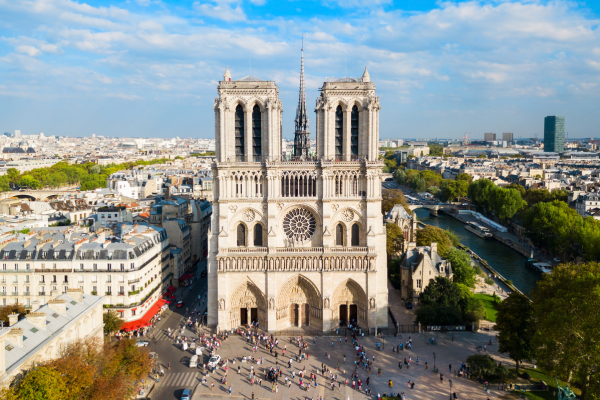
As Notre Dame burned in 2019, some believed that the unique acoustic measurements also burned. Daniel Williamson speaks to the acousticians who reconstructed the sound of the famous French landmark.
The Notre Dame Cathedral took 182 years to build. Construction began in 1163 on Île de la Cité, under the reign of King Louis VII, and it was largely completed by 1345.
ADVERTISEMENT
The inception of “Our Lady of Paris” goes back even further to the three-digit years, literally thousands of years ago. Clovis, the first King of the Franks, established Paris as his capital in 496. During this time, the city was home to the Saint-Etienne Cathedral. Bishop Maurice de Sully decided to replace it with a grander, Gothic-style Basilica, leading to the production in the 12th century.
1,523 years later, at around 6:30pm on Monday, 15 April 2019, the Notre Dame Cathedral burned until the next morning. To this day no culprit has been found, and it’s believed to be the cause of an electrical fault or smouldering cigarette butt.
In December 2024, Our Lady of Paris reopened to the world after six years of planning, rebuilding and refurbishing.
But amidst the tragedy, a rare glimmer of light emerged. Not in stone or stained glass, but in sound.
Sorbonne Université acoustician and researcher, Dr Brian Katz, visited Notre Dame long before the haze arrived. As part of the French applied research project Binaural Listening (the BiLi Project), the team focused on bringing binaural audio out of the laboratory and making it accessible to the general public. Through partnerships with French television, radio and the music conservatory (CNSMDP), the team recorded the 850th anniversary concert of Notre Dame Cathedral in 2015. The team successfully made a virtual concert experience for those who couldn’t attend the performance, resulting in a 360° YouTube ‘Ghost Orchestra’ virtual concert.
Brian’s team returned to the cathedral to take a series of highly detailed acoustic measurements, data that allowed them to construct a 3D model of its sonic environment. This is what allowed the group to digitally recreate the concert: not just the music, but the way it moved through the cavernous Gothic space.
Perhaps by fate, or perhaps by sheer luck, who would have thought that Brian’s team was the only one with these measurements?
“After the fire in April 2019, I was contacted by a colleague who asked if I still had the acoustic measurements we took. It turns out that ours were the only published acoustic data available at the time,” Brian explains.
Around this time, Brian had recently changed laboratories, having moved to Sorbonne Université.
“With the fire, the concern for the historic acoustics of the cathedral and our previous work, the call to action was clear,” he says.
“In the immediate aftermath of the fire, several associations were being formed of various specialists. The French National Centre for Scientific Research (CNRS) and the Ministry of Culture then formed a joint scientific working group for the restoration of Notre Dame, the Chantier Scientifique de Notre Dame.”
Brian explains that the assembly consisted of scientists from many fields, organised into nine thematic groups to offer support to the actual restoration team. Alongside his colleague Mylene Pardoen, a specialist in historic soundscapes, he led the acoustics team.
Initially, they didn’t know how important the acoustic measurements would be. It seemed that the digital model was unique enough. If there were proposals for modifying the building in the restoration, the 3D model allowed the team to rapidly evaluate the impact on the acoustics. Having the model meant that they could get many months ahead of any other acoustician who could be brought into the restoration team.
“It was only when we started looking into more detail that we realised that the measurements we had been taking were rather exceptional,” Brian says.
“I have not found any other measurements outside of those we made, or those that prior members of our laboratory carried out in the 1980s. These earlier measurements, recovered from reel-to-reel tapes in our archives, already provide a picture of the evolving acoustics of the cathedral due to changes in furnishings or decorations.”
Then came the team’s first major project – refine the acoustics model into a precise and modular research tool.
Brian’s former PhD student, Sarabeth S. Mullin, led the task of extrapolating the model from the 2015 version to numerous historical states, all the way back to the opening of the cathedral in the 12th century! Modern technology, hey?
This tool became the centrepiece of the team’s research on the evolution of Notre Dame’s acoustics.
“The basic idea is that we are trying to create a grid across the entire occupied regions of the cathedral. Essentially, a trace of the sound as it moves from the loudspeaker where we placed it, to a variety of microphones scattered around the area. It gives a lot of special information and a lot of energetic information,” Sarabeth explains.
Brian explains that the measurement grid is intended to cover as much of the interior space as reasonably possible in the time allotted.
“We chose source positions (speakers) at various typical sound locations (preaching, singing, organ) in history and then have a scattering of microphone positions at plausible listening and occupied areas,” he outlines.
“The goal is both a global picture and the finer details that can be used to further refine the acoustic model as well as to compare to prior measurements.”
During the post-fire reconstruction, the team encountered many obstructions. Faced with basic construction restrictions, the collapse of the spire and partial destruction of the roof meant there would be limited access and no people allowed under the central vaults in case of a collapse. To overcome this, Brian’s team resorted to using man’s best friend – robots.
“We found a company that rented sewer inspection robots. We rented one for the day and hooked up a series of two or three tripods on wheels. It pulled all our microphones down the centre of Notre Dame while we did measurements,” he says.
If these obstacles weren’t enough, the team had to work through lead contamination and, of course, COVID-19 restrictions.
“All these restrictions in general meant that there was limited access to the cathedral and only so many people could enter at a time,” Brian explains.
“With immense national pressure to reopen, there were artisans and workers around the clock working on all aspects of the reconstruction.”
Six years after the fire, in December 2024, Notre Dame reopened. The world marvelled at the restored stonework, stained glass and soaring spine – but just as important was something less visible: the sound.
Thanks to the efforts of Brian, Sarabeth and their colleagues, the cathedral’s unique acoustics were preserved and reimagined. The team’s AV techniques helped ensure the space sounds as breathtaking as it looks.
Though their contribution doesn’t stop there. Vaulted Harmonies, a virtual concert film based on their 3D acoustic model, will allow audiences around the world to experience the ethereal soundscape of Notre Dame without ever setting foot in Paris.
“Notre Dame is a living monument, continually evolving, with this fire and subsequent restoration being the most recent step,” Brian concludes.
The work continues
Another offshoot of Brian’s acoustic research is Notre-Whispers, a free 3D binaural audio guide created by former PhD student Julian De Muynck. The guide allows listeners to explore the cathedral’s interior from an auditory perspective, either on-site via GPS or from anywhere in the world.
Projects like this, along with Vaulted Harmonies, were made possible thanks to funding from the EU project The Past Has Ears (PHE) and its national counterpart The Past Has Ears at Notre-Dame (PHEND).
It’s an example of how technology can carry heritage forward, and not just rebuild what was lost, but expand who gets to experience it.
-
ADVERTISEMENT
-
ADVERTISEMENT
-
ADVERTISEMENT
-
ADVERTISEMENT