
From gear to guidance: How integrators turn service into strategy
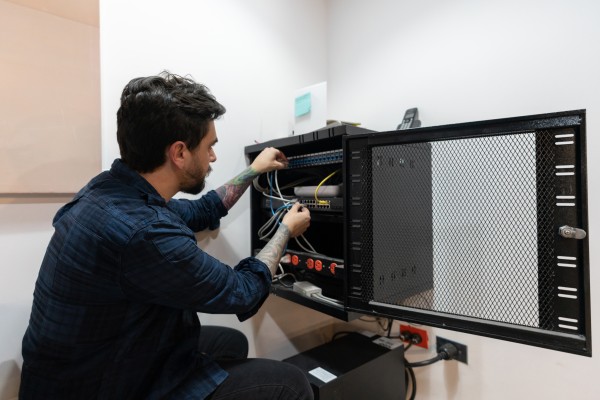
The role of the traditional AV integrator is shrinking as products become more efficient. Casey McGuire explains how data, automation and software are opening up new opportunities for the market.
Back in the day, a traditional AV installation for an integrator would involve multiple microphones, speakers all around the room and cameras to capture every moment. Today, technology has grown so much that a lot of these products are consolidated into a few. An AV installation has gone from a day’s work to less than an hour with soundbars, beamforming microphone solutions and automatic PTZ cameras giving end users everything they could want.
ADVERTISEMENT
Building on that, Neat recently launched the Neat Board range of products, an all-in-one AV solution that’s on wheels. Some end users are opting for the plug-and-play product on wheels simply for the flexibility, almost eliminating the need for a traditional AV installer altogether.
With traditional AV installations potentially evaporating, how do integrators continue to hit their bottom line? That’s where services, reliability and data come in.
For integrators who have service level agreements (SLAs) with customers, they’re usually contracted for three or five years. When going into a new financial year, there’s a certain amount of money that’s already on the books because it’s contracted. The integrator enters knowing they are going to start with a certain amount.
If you don’t have an SLA, and your business relies on how much the market is willing to spend, a downturn can hit hard because project work dries up.
In a business that combines managed services with project work, a slowdown in projects doesn’t have to be a problem. You can focus on your managed services, offer more to existing clients and expand your service portfolio instead of just waiting for the next big deal.
“From the integrator’s point of view, we are getting to a point where promising a client that I’m going to give you a contract that keeps all your technology running just is not enough,” Insight Systems director of technology Myke Ireland says.
“Customers are now asking, but what else comes from your service contract? What are you going to give me? Are you giving me data and analytics on how I use my spaces?”
He has found that, increasingly, customers want data and analytics on how their spaces are used.
When speaking to Myke, he showed all the analytics that he’s able to gather from an installation in one of Australia’s leading universities. Insight Systems collects this data for weekly reports that they present to the client alongside possible reasons and suggestions on how to optimise their spaces. The client can then implement the knowledge to make adjustments, all along the way, strengthening the relationship with the integrator.
Say you have four ten-seat meeting rooms that are always booked. On paper, utilisation looks high. But with occupancy sensors or cameras, you can see how many people are actually in the room. If the data shows those ten-seat rooms are consistently being used by only two people, the system can flag underutilisation.
With that knowledge, the software can automatically reassign smaller meetings to four-seat rooms, freeing up the larger rooms for bigger groups, optimising both space and efficiency.
Or from an operational point of view, the client might want to split this room into two smaller meeting spaces or use it as data for when/if they move locations.
“This is the next level of stuff that clients are demanding from SLAs. SLAs that promise the gear will work are not enough anymore. We’re seeing people hungry for data and info on how the systems are being utilised,” Myke outlines.
At the heart of ADI | Snap One is OvrC, whose connected ecosystem is the OvrC Hub, a compact, standalone device that plugs directly into the network to give integrators complete visibility and control. It allows professionals to remotely monitor, manage and troubleshoot systems with ease.
The Pro Hub is also built into every Control4 controller, as well as Araknis routers, meaning seamless integration and full network insight come standard. Whether through a dedicated OvrC Hub or the embedded technology within Control4 and Araknis products, professionals gain a smarter, more efficient way to support and service their clients’ connected spaces.
ADI | Snap One technical trainer Peter Wilson educates integrators on how to use OvrC, Control4 and other products in the portfolio.
“I don’t think it’s actually communicated enough to the customer to get them to understand just the power of what remote management is and what it’s capable of doing. Our products aren’t really customer-facing, so we leave it up to integrators and dealers to be able to spread the word,” he says.
“When people know the value of what OvrC actually is and what it’s capable of doing, it’s not hard to understand the value of it and that things can be resolved.”
Integrators with authorisation can schedule automatic router reboots weekly through OvrC to keep systems running smoothly and eliminate potential lag.
“I’ve heard of many stories where things have been resolved proactively, where the customer didn’t even know something had fallen over. They have just rebooted and fixed it, because you get notifications, so they are then able to go and fix it before the customer knows it happened,” Peter explains.
A potential issue that Peter identified was a hesitation in believing in the system because OvrC is a cloud-based service. When companies have their own networks, in Peter’s experience, they typically don’t want things sitting on their networks.
“Obviously, they’re always around it by segregating the networks and being able to see what’s going on. If there’s any hesitation, it will be because of that, because commercial-grade networks don’t really like other things snooping around and looking at what’s going on in their network,” Peter says.
The residential market has been the stronger presence for OvrC in recent times, but the commercial side has seen OvrC become more common.
Not only does the system provide proactive insight when issues arise, allowing integrators to resolve them quickly, but it also tracks upgrade needs. Firmware and software updates are flagged as soon as they become available, visible on the website, so integrators can easily see which products require updating and keep systems running at peak performance.
“In our world, people always think, ‘if I get a bit of software, it’s going to be the one that is from the biggest brand that has the most support,’” Myke says.
“That’s okay, but the problem is you will still have to customise it and you will very likely not end up with something that suits your specific needs.”
If you look at a Microsoft roadmap, you get features only when they’re ready to release them, which does not suit every client. Myke’s approach is different: They own the software stack. If you need something, they will build it within 30–60 days. This lets customers address their unique needs instead of relying on a one-size-fits-all solution, which rarely meets every requirement.
“Generally, with smaller businesses, they don’t have a ton of manpower and if it’s a one-man-in-his-van scenario, it’s going to make their life a lot easier, because they’ve got one go-to that’ll help deploy these things,” Peter says.
“Beyond that, from the serviceability side of things, it’s going to help them in the fact that they might be able to stop that truck roll because it might be an hour to the site, an hour on site and an hour back where they could have just logged in and done whatever needed via the app or the web to fix that.”
ADI | Snap One doesn’t charge for OvrC; there’s no cost attached to those registering for the service. It’s a real time-saver to start with, though some businesses do include it in a service contract. In those cases, they charge for it as part of their 24-hour monitoring service, allowing them to proactively manage and maintain a client’s site.
“OvrC’s primary role started out as more visibility into the network and whatever it was currently connected to,” Peter says.
“It was giving the user the ability to log into a site to see what devices were on and offline, and with that, being able to potentially do some low-level troubleshooting to actually try and resolve the issue.”
Part of the problem-solving challenge is that technicians often can’t reboot devices or gain deeper insight into which products may have gone offline. In many cases, a simple power reboot on-site would fix the issue.
When an integrator installs a TV on a wall, they guarantee it won’t fall, and if it does, or if a cable comes loose, they’ll replace it for free. To do this, the display may need to be removed so the integrator can check the wall, and they may ask the customer to provide firmware logs in advance. For most customers, they will have no clue what a firmware log is.
This is where the service provider steps in. They manage everything that goes wrong with the gear. While the manufacturer’s warranty covers some issues, the service provider handles all the complications in between.
So, instead of calling 15 different manufacturers, the customer just calls the service provider, who coordinates with the rest. Within this model, there’s also potential to implement an SLA for added assurance.
“That value is then what we roll into a contract, and then that can repeat year on year,” Myke states.
“It’s a very custom approach to things where it’s understanding the client’s specific needs and building service around that, as opposed to a one-size-fits-all model.”
Clients who are tech-savvy and want to showcase the latest technology usually operate on a five to seven-year lifecycle. These days however, by the third year, the next iteration is already well underway. So, a good SLA is going to take this into account and include options that allow the system to grow and adapt with the client’s needs and the greater technology curve.
In contrast, institutions like universities, which manage massive fleets like 800 rooms of equipment worth $50–60 million, can’t afford to upgrade that frequently. They often follow a seven to ten-year lifecycle to get the most value out of their assets. In this environment, software becomes the real play. Hardware simply won’t stay relevant for a decade, but choosing hardware that relies heavily on software means it’s more flexible, and you can work with that over longer time frames.
A couple of years ago, Myke had lost a tender that they were confident on winning but didn’t due to an array of reasons, but price is usually a top contributing factor.
In this case, about halfway through the awarded deployment, the project was going so poorly that the customer reached out and said, ‘This isn’t going well, and we think the wrong person is handling the work.’ Contractually, they had to finish the install, but once it was done, they were asked to come in, assess everything and take over the managed SLA.
That turned into three more years of service. Years later, the original installers never saw the client again. It’s a unique opportunity for businesses that deliver exceptional service: You might not win the initial project, but you can still secure the ongoing service work.
It is difficult enough already to find jobs, so making sure a project is seen from start to finish is essential.
“In the world that we’re going into now, everyone’s laying people off because of technology, automation and AI. If you are not bringing AI, software and automation into your service, you’re finished,” Myke says.
“If your service is just people, start your stopwatch because you’ve only got a limited amount of time left in the world, because that equation can’t balance anymore.”
The shift isn’t just coming, it’s already here. Businesses that once relied solely on manpower are being forced to rethink how they operate, as clients demand faster, smarter and more efficient outcomes. Integrating automation and AI isn’t about replacing people for the sake of it, but about evolving to stay relevant in a market that rewards innovation and scalability.
“If you can replace people with software or people with AI or automation, now you’ve got an offer,” Myke insists.
“If you don’t have a software solution as part of your service delivery, you’re actually not in service, it’s just project work that’s wrapped up as service.”
-
ADVERTISEMENT
-
ADVERTISEMENT
-
ADVERTISEMENT
-
ADVERTISEMENT