
Digital twins promise to super smart the already smart homes
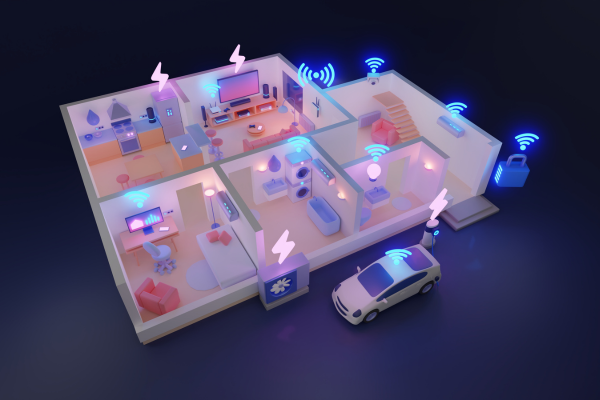
Will digital twin technology take off? Stuart Corner explores the current use cases and how the technology could apply to the AV integration world.
There’s a video on YouTube posted by someone who goes by the name Tinker Tut. He demonstrates how he has created a digital replica of his entire house. This replica includes interactive icons for every one of his myriad smart devices, from light bulbs to TV sets, computers and printers.
ADVERTISEMENT
He can click on any one of those icons and gain full access to that device. He can change the brightness and colour of LED lights and see that change reflected in the digital version of the room on his screen, see what is playing on the TV, see what is printing on his printer and check ink levels, control his son’s PlayStation and see what game he is playing.
The title of his video? My Smart Home Digital Twin: A Real-Time 3D Model of My Home!
It’s a useful, albeit limited, introduction to the digital twin, a concept already well established in industrial applications of the Internet of Things (IoT), but relatively new to the smart home domain.
So new, in fact, that ChatGPT doesn’t even recognise its application to the smart home. If you ask ChatGPT to tell you about digital twins, the only applications it lists are manufacturing, healthcare, smart cities, aerospace and automotive.
However, ChatGPT does give a pretty good definition of a digital twin, anthropomorphism aside.
“A digital twin is a virtual representation of a physical object, system or process that is used to understand, simulate and optimise its real-world counterpart. It combines data from the physical world (via sensors, IoT devices, etc.) with digital models to create a living, evolving digital replica.”
The key words here are “understand, simulate and optimise.” A true digital twin doesn’t simply enable monitoring and control: It’s able to use these abilities to gain insights into the system it replicates, be that a smart home or an industrial process, and then act on those insights to optimise processes, anticipate problems and more.
Impressive though it is, Tinker Tut’s digital twin, as demonstrated, is merely a consolidation and useful presentation of the controls for every smart device in his home. What has driven the embrace of digital twins by all the industries listed by ChatGPT is their ability to understand, simulate and optimise their real-world counterparts (see box-out for examples)
At GE’s gas turbine power plant in Bouchain, France, the digital twin gathers real-time data from sensors installed in the turbines, analyses it and offers suggestions for proactive maintenance and performance improvement. GE can predict possible problems before they arise by simulating various operating situations and scenarios, which lowers unplanned downtime and boosts operational effectiveness.
Unfortunately, smart home digital twins have not reached anywhere near the maturity of their industrial counterparts, but here is just one example of what a digital twin of your home, backed by artificial intelligence (AI) might be able to do.
It could monitor all the heating and cooling systems in your home, your solar panels and storage batteries and combine this information with an understanding of your normal behaviour patterns and with external weather data to optimise energy usage, balancing use of grid power, solar power and sale of solar power to the grid.
Such functionality would be made possible by the digital twin bringing together and integrating the monitoring and control of multiple distinct smart devices and using AI to analyse and act not only data from individual devices, but the interactions and interdependencies between them. It is yet to be realised in a commercial product, but there are some signs of progress.
There is another YouTube video of a smart home digital twin very similar to Tinker Tut’s. It was posted by James Litjens, associate director, emerging technologies with Melbourne IT consultancy Arq Group (now part of NCS Australia).
He spent several months during the COVID lockdown building the system and says: “We encourage Arq Group to turn this into a product platform of some kind, so that homeowners can have plug-and-play integration of devices, appliances, systems, data, etc. This would foster an intuitive dashboard/model that homeowners can use to manage their homes.”
Since then, Arq Group has become part of NCS Australia and while that company is very active in industrial digital twins, it does not appear to have made progress on domestic versions. Our enquiry to the company had received no response at the time this article went to press.
Many industrial digital twins like those described above are developed using commercially available software tools: AWS IoT TwinMaker, Microsoft Azure Digital Twins and Siemens Xcelerator. Any of these could be used to build a smart home digital twin with advanced functionality, but it would be very much a bespoke and costly solution.
However, it’s likely that smart home digital twin technology will evolve so that it can be easily customised for an individual home.
For example, low-code software tools enable computer programs to be created without programming skills. These tools use pre-written software modules that can be activated, assembled and adjusted through visual representations and drag-and-drop interfaces.
They are widely used to enable people with specialised knowledge to incorporate that knowledge in a computer program and could be applied to ease the creation of a bespoke smart home digital twin.
In the meantime, there is no shortage of academic activity around the concept: Plenty of research papers can be found on the net. One paper, published on the Association for Computing Machinery Digital Library, even proposes a new name for the smart home digital twin: The ‘Meta-Home’, a combination of smart home technology and Metaverse technology.
So, if this article has whetted your appetite for exploring the potential of digital twins in your smart home, you might be feeling a bit let down.
But do not fret, there are some possibilities. Tinker Tut, with whom we introduced the concept, has started what he promises will be a series of YouTube videos explaining how he created his version of a domestic digital twin using Home Assistant (free open-source software for home automation) and a Raspberry Pi.
At the time of writing (late May), he had posted only the first in the series, but if you feel up for the challenge, good luck!
-
ADVERTISEMENT
-
ADVERTISEMENT
-
ADVERTISEMENT
-
ADVERTISEMENT