
CES: Constantly exaggerating specifications

New year, same misinformation. Michael Hamilton takes aim at one of colour science’s most persistent myths, and the YouTube tech bros who keep milking it for clicks.
Though the calendar has flipped, proclaiming this is 2026, in the video world, the four-digit numbers re-aiming the spotlight aren’t tied to a date. A duo better known as ITU-R BT.2020 and ITU-R BT.2100, along with their sidekick SMPTE ST 2084, continue to push experimentation with pixels beyond the bold frontiers of last year.
ADVERTISEMENT
So yes, the calendar says 2026, but in Las Vegas on the CES 2026 tradeshow floor, it was all about 2020 colour space, 2,100-plus nits of luminance, and 2,084 reasons for the YouTube Influencer-azzi to saunter, iPhone selfie sticks thrust aloft, signalling the aisles to part for them like Charlton Heston’s staff parting the Red Sea as Moses in The Ten Commandments (1956).
Forget New Year’s resolutions, for these self-anointed FPS philosophers, clickbait cultists and shameless sellout shamans, higher resolution and 110% ITU-R BT.2020 colour coverage are the only commandments worth a damn on their tablets, mobile tablets though they might be.
New Year’s ‘W8’ loss…
Like excess pounds destined for the semaglutide jab, 8K flat-panel televisions at CES 2026 were seemingly at the top of most manufacturers’ no-can-have diet list, save for Samsung.
Perhaps when HDMI 2.2 chipsets become commercially viable, and the staggeringly stratospheric promise of 96Gbps bandwidth makes resolutions up to 16K feasible, or if the competing alternative General Purpose Media Interface (GPMI) overcomes backward-compatibility constraints and resolves international licensing hurdles, renewed market demand for 8K and higher-resolution displays will resurge.
BT.2020 In A.D. 2026
With resolution taking a back seat, pixel and subpixel innovations became the dominant theme for flat-panel TVs at CES 2026. Nearly every manufacturer declared that their top display technologies achieve 100% ITU-R BT.2020 chromaticity gamut coverage.
Projector manufacturers upped light output from compact chassis designs, with almost all using RGB laser light engines claiming to reach more than 100% ITU-R BT.2020. Of course, the influencer-azzi were on hand to reinforce these claims, with zero backing proof, aside from their decibel-laden “best I’ve ever seen” incantations.
1968 and 2001
Film enthusiasts will recall the iconic moment in Stanley Kubrick’s masterpiece 2001: A Space Odyssey (1968), when the hominid known as Moon-Watcher hurls a bone skyward, a symbol of humankind’s leap from tools to weapons before it transitions, through a brilliant match cut, into a spacecraft drifting silently through the void, likewise a modern instrument born of both utility and conflict.
In a CES flight-of-fancy parody, I reimagine a selfie stick tethered to an iPhone, mysteriously cast upward, arcing languidly in slow motion above the convention floor, an allegorical echo of the film’s vision of tools evolving into weapons before being turned upon their makers. Descending gracefully, it lands upright, emulating TMA-0, the iconic black African plains monolith, heralding a moment of revelation for the Influencer-azzi: Behold, the dawn of your enlightenment.
The YouTubers approach, confronting the dreamscape cuboid, but unlike in the film, they are not met by the swirling micropolyphony of the Kyrie from György Ligeti’s Requiem, rather by HAL 9000’s calm, unsettling, precise monotonic droning regarding ITU-R BT.2020 and consumer displays: “I’m sorry, boys. I’m afraid they can’t do that.”
As AI continues to redefine global technology sectors, the gospel of 2026’s wide-colour-gamut displays is zealously promoted by evangelistic YouTube shills and ardent fanboys. Eerily akin to the hypnotic grip that AI’s quintessential firstborn, HAL 9000, exerted over the Discovery One crew before Dave Bowman forced HAL’s inevitable shutdown, they stand entranced in front of the newest, colossal flat panel – as big as a road train – backlit, ablaze in a blinding flood of a million mini-LEDs.
Each larger display encountered evokes even more exaggerated facial expressions and gesticulating arm movements, hauntingly reminiscent of Premier League soccer injuries.
Mythical numbers
At CES 2026, flat-panel manufacturers Hisense, LG, Samsung and TCL all issued press announcements for TV models they claimed achieved 100% BT.2020 coverage, with Hisense promoting its 116UXS as having 110% BT.2020 coverage. I will address as to how they arrive at this further below.
While such exaggerations may seem like harmless marketing peccadillos, they nonetheless reveal an industry intent on shaping consumer perception rather than engineering genuine performance to determine the outcome.
At issue is an important distinction between BT.2020 area and BT.2020 coverage as defined by the location of the primaries on the spectral locus, the curved outer boundary of the CIE 1931 chromaticity diagram (see Figure 1) that delineates the most saturated, monochromatic colours within the visible spectrum, spanning wavelengths from 380-780nm.
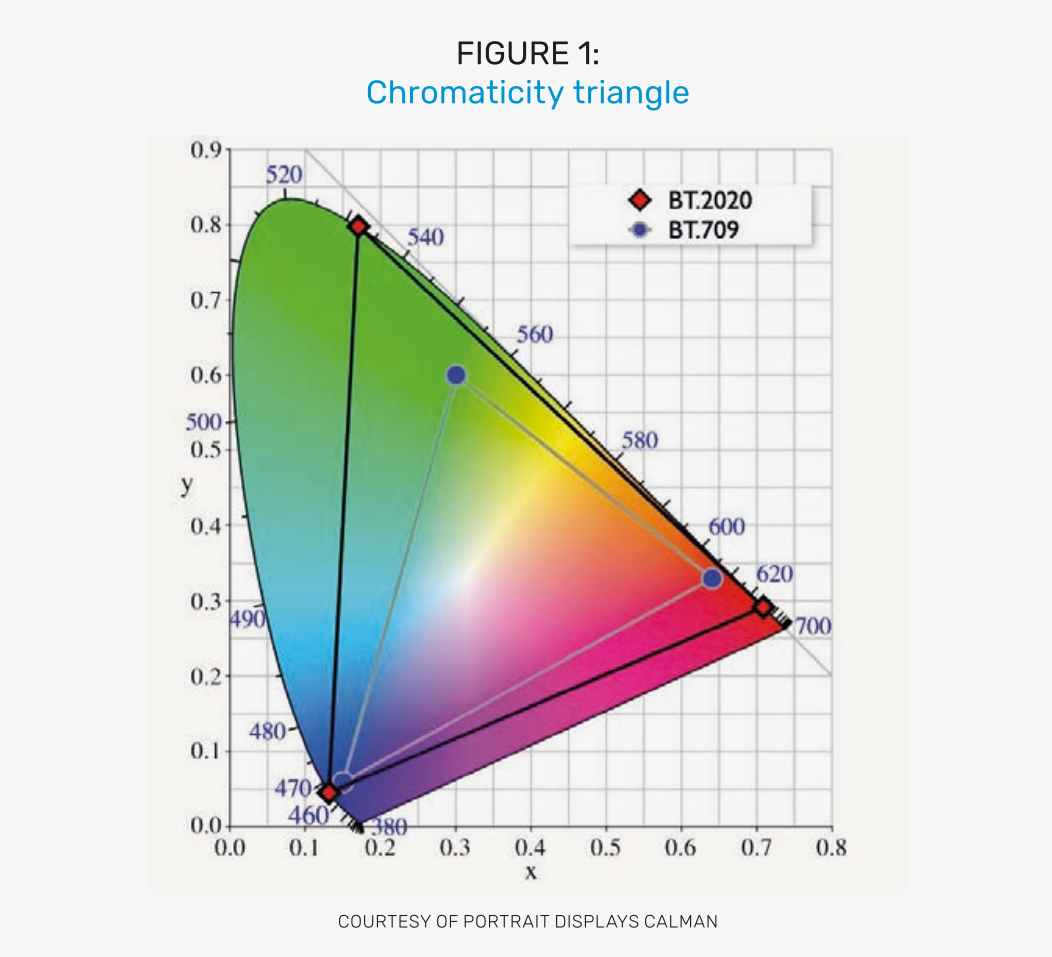
When referencing the BT.2020 colour gamut, manufacturers often cite “100% BT.2020 coverage” in their marketing materials. However, this metric overlooks the geometric displacement of chromaticity coordinates along the spectral locus.
The BT.2020 standard defines its gamut boundary on the CIE 1931 chromaticity diagram using three precisely specified monochromatic primary wavelength peaks: 467nm for blue, 532nm for green and 630nm for red. Originally proposed by Kenichiro Masaoka and Yukihiro Nishida at NHK’s Science & Technology Research Laboratory, this specification was later adopted by the ITU Radiocommunication Sector as the colour gamut for Ultra-High-Definition Television.
Deviations by manufacturers, as minor as a single nanometre from one of the BT.2020 specified coordinates, may help to create a measurable chromaticity triangle representing 100% of the area of BT.2020, but this is not the same as a chromaticity triangle overlapping the specified ITU-R BT.2020 primaries, representing the gamut’s true size and shape, signifying 100% coverage.
Claims exceeding 100% spectral coverage are scientifically invalid and pure nonsense. Colours beyond the spectral locus are purely theoretical constructs. Those colours simply don’t exist in the natural world.
Such shifts, whether imposed by manufacturers or inherent to flat-panel technologies, induce aliasing in nanometre coordinates, deviations that effectively result in different spectral locus positions from those of the monochromatic primaries that define BT.2020. These shifts serve to rearrange the colour reproduction limits that influence the relationship of the primaries to the perceptual boundaries of human vision.
The altered locations of these primaries result in measurable errors in gamut mapping, display calibration and colourimetric accuracy across imaging systems.
ITU-R BT.2020 by the nanometers: Who makes the cut?
The technical capabilities of available flat-panel display technologies in the marketplace, including models introduced at CES 2026, remain insufficient to fully reproduce the complete colour gamut defined by Recommendation ITU-R BT.2020.
Not LCDs
Flat-panel LCD displays, irrespective of their backlight design, cannot achieve 100% BT.2020 coverage due to fundamental limitations in light-emitting diode technology and LCD panel architecture. LEDs, including quantum dot enhancements or Mini-LED configurations, emit light over a range of wavelengths and are incapable of the monochromatic precision necessary to eliminate crosstalk while matching the BT.2020 primaries at their exact nanometre spectral locus coordinates.
Additionally, this spectral width, referred to as crosstalk, causes colours to bleed into adjacent primaries. Blue LEDs, even at the BT.2020 specification of 467nm, leak into green, distorting the gamut triangle with no possibility for the overlap needed to match. LCD panels require filtering to enable the liquid crystals to regulate the amount of backlight allowed to pass through. Filters are also used for colour generation and colour mixing to create hues. While effective for colour creation, filters transmit undesired wavelengths, which augment crosstalk.
Not OLEDs
Spectral bandwidth issues also hamper organic light-emitting diodes from monochromatic precision, even in advanced Quantum Dot OLED models. OLED diodes produce light with a full width at half maximum (FWHM) between 20nm and 50nm. FWHM offers a simple metric for measuring signal bandwidth, resolution, and performance in materials used to create video displays. FWHM measures the spectral width of a light emitter, such as LEDs or lasers, at half peak intensity to determine colour purity and clarity.
In theory, molecular redesign could tune OLED emission spectra to align with BT.2020 primaries. However, the resulting efficiency losses and the high power needed to reach target luminance without spectral crosstalk make this approach impractical for now.
Not direct-view MicroLED
A broader spectral bandwidth, common to those plaguing LED designs of all types, impacts direct-view MicroLED emitters. Gallium Nitride (GaN), the semiconductor substrate that has made a profound impact on audio amplifier performance in the past decade, may similarly contribute to revolutionising MicroLED display performance.
MicroLEDs aiming at high light output incorporate GaN-based blue MicroLEDs (at approximately 465nm), but resort to converted green and red phosphor coatings for the creation of the full colour spectrum. The technology is still incapable of hitting the exact monochromatic peaks for the BT.2020 gamut.
Indium Gallium Nitride (InGaN) LEDs, while highly efficient light sources for blue, green and white light generation, currently only achieve 76-84% of BT. 2020 gamut. The wavelength of InGaN LEDs can be altered by adjusting the proportion of indium to gallium (their bandgap), to range from near-ultraviolet and blue to green, with a promise for red forthcoming. High indium content is needed in InGaN to develop longer wavelengths, like the 630nm required for BT.2020 red.
For now, one difficulty arises from the lattice mismatch between gallium and indium. In layman’s terms, a lattice mismatch refers to the alignment accuracy of the atomic grids (called crystal lattices) of two materials when you try to grow one on top of the other. Spacing differences strain the materials when grown together, like forcing bricks of unequal lengths into a wall, leading to defects, cracks or phase separation that inhibit LED performance.
High-quality growth is tough, as greater indium content worsens the strain. InGaN offers the energy efficiency needed as flat panels grow to gargantuan sizes.
The one that is oh so close…
Figure 2, below, is the spectral response for Sony’s BVM-HX3110 Mastering Monitor, taken by a Colourimetry Research CR-300 Spectroradiometer, the Hollywood benchmark for spectral devices, using Portrait Displays Calman software.
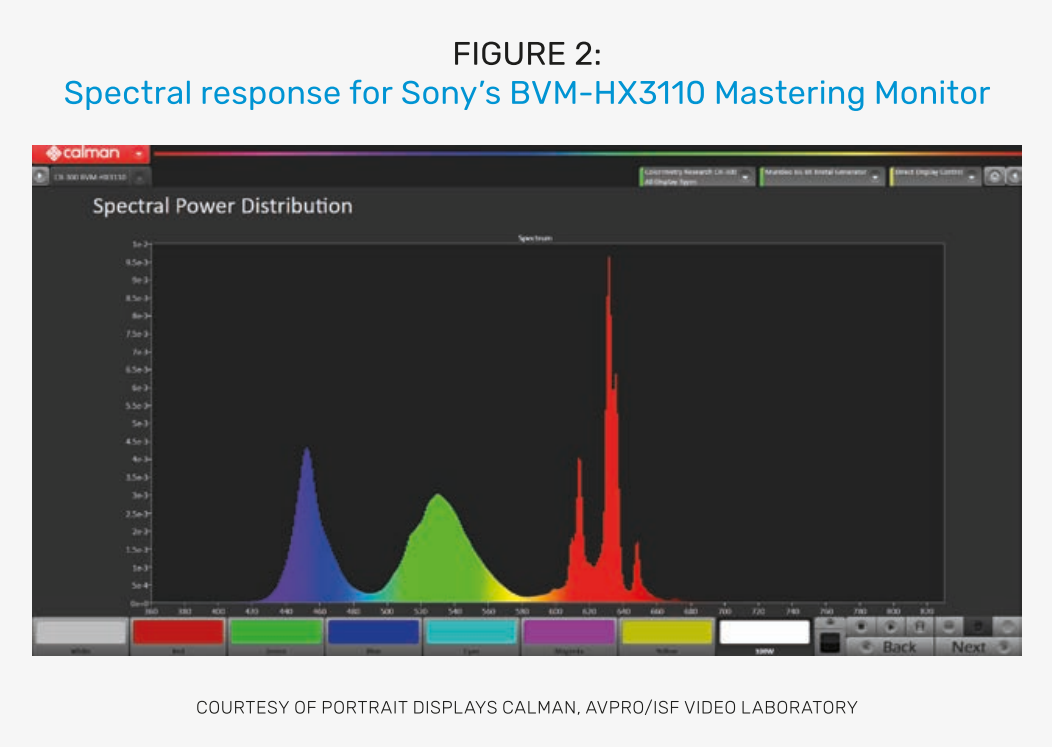
The monitor features a custom-designed α-Si TFT Active Matrix LCD dual-layer anti-reflection LCD panel engineered by Sony.
Note where the RGB wavelengths plot. The blue spike appears to match 467nm, the green spike is very close to 532, and the red spike is nearly bang-on, at 630nm. Yet Sony, ever so cautious, publishes that the BVM-HX3110…
Whether it is Sony’s legal department or the engineering lab in Tokyo, the asterisk is there for a reason, leaving us with just one place to turn…
Lasers make the cut
For now, RGB laser projectors with light engine primaries engineered to exact BT.2020 monochromatic nanometre wavelengths.
Looking forward
In the next instalment of The ‘V’ in AV, we will discuss what the BT.2020 colour gamut provides to viewers and what some companies are doing to come close to the motherlode.
And as a side note, I’m a technical contributor for RP23, and I can mention that each Zoom session brings measurable progress. Just as RP22 provided a comprehensive framework for defining objective performance standards and guidelines for the design, installation and verification of immersive audio systems in home theatres, the corresponding parameters for video are supported by an equally extensive set of documentation.
It is hoped that the combination of RP23 and CEDIA RP1 (dubbed Performance Facts) will contribute to helping manufacturers specify products uniformly, free from marketing double-speak.
I still remember the absurdity observed at the last CES that I elected to attend, where one exhibitor proudly boasted about having ‘the world’s largest 100” television.’ Sure. I suppose it sucked to have been showcasing the world’s second-largest 100” TV.
-
ADVERTISEMENT
-
ADVERTISEMENT
-
ADVERTISEMENT
-
ADVERTISEMENT