
Bluesound POWERNODE
The multi-room audio wars are on with Bluesound’s latest venture into this space. Myke Ireland checks out the kit to see how it stacks up.
I love it when I get the chance to review technology that leans more toward the consumer market. Most of my time is spent deep in the commercial AV world; racks, codecs, Dante flows and the occasional cable tangle that defies logic, so it’s nice to geek out over something built for the home from time to time.
ADVERTISEMENT
When the opportunity came up to review the Bluesound POWERNODE, I jumped at it. Mainly because, at home, I already live with the other brand. You know, the “palindrome company”, whose name reads the same forwards and backwards? My home is actually packed with it, so whilst the testing ground isn’t exactly neutral, it’s the perfect place to see if Bluesound can truly hold its own against the familiar heavyweight.
Having followed the multi-room audio wars of the past decade, you’d be forgiven for thinking the palindrome crowd had already won. The race looked over before it really began. Sure, a few players like Samsung and Sony joined in, and for them, the venture was really to extend on their TV lines, but only a handful stayed truly dedicated to whole-home audio as their core mission. And that’s where Bluesound comes in.
The story feels much like Apple’s quiet years in the 90s, when many assumed the company had faded. Bluesound, in a similar fashion, has been quietly refining its craft. Real innovation, after all, doesn’t always make noise while it’s happening.
While today’s review is mostly about hardware, you can’t talk multi-room audio without considering the software that drives it. When the software is bad, everything is bad. The POWERNODE sits right at that intersection, audiophile-grade sound shaped by smart, reliable software that understands how people actually live and listen.
Out of the box
A big thanks goes to Amber Technology, the Australian distributor for Bluesound, for sending me a brand-new, factory-sealed POWERNODE. That meant I got the rare pleasure of a true unboxing experience, something that’s often overlooked in the commercial AV world, but genuinely matters when you’re back in consumer territory.
And you feel it right away. The box looks premium, feels premium and opens like a product that knows exactly what it’s worth. Inside, everything’s laid out with an understated confidence that says, “we’ve thought about this”.
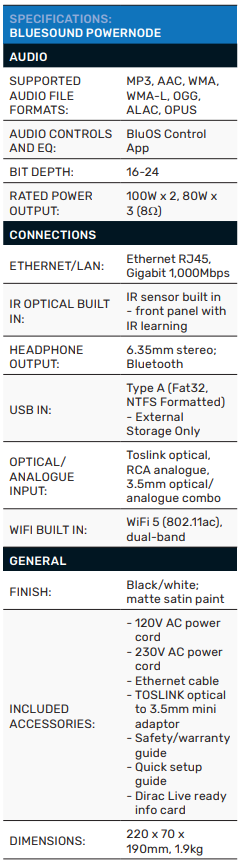
You’re greeted with the usual quick-start guides and documentation, plus the essential cables to get going: power, optical conversion and even an Ethernet lead if you prefer a hardwired connection.
The POWERNODE itself comes wrapped in a soft white linen bag, a small but appreciated touch that likely prevents scuffs during transit, but also reinforces that sense of craftsmanship. It’s that extra 5% of thoughtfulness that helps a product feel special before you even plug it in.
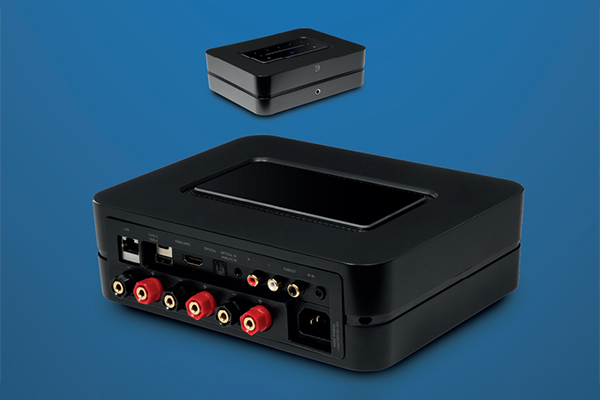
Up top, the capacitive touch interface immediately grabs your attention. It handles everything from input selection to track navigation and gives subtle status feedback through its illuminated controls. The P-Cap volume slider in particular is a joy; run your finger across it, and the level smoothly tracks your motion. It’s clever, modern and just tactile enough to remind you you’re using something built for people who care about the details. Because, as we all know, volume should never be based on incremental steps alone.
On the front, a chunky, dedicated headphone amp output stands ready for more private listening. Plug in a good set of cans, and you’re instantly in that audiophile headspace, no external DACs or half-measures required.
Round the back, Bluesound covers every base you’d expect from a serious hi-fi device. You’ve got HDMI with eARC support, dual optical inputs (one doubling as a 3.5mm analogue in), RCA connections, subwoofer out and even an IR input for integration with TVs or automation systems. The speaker terminals support front left, right and centre channels, plus a passive sub-out, all clearly labelled and solidly built.
And yes, it’s heavy. Which is, of course, a good thing. The moment you lift it, you can tell this compact box hides amplifiers with real authority, and when it comes to amps, mass equals promise. The promise that when you finally power it up and push it to eleven, you’re going to hear exactly why Bluesound still deserves a seat at the top table of multi-room audio.
Streaming ecosystem
The thing about the Bluesound ecosystem is that it rewards users who understand what it is, and what it isn’t. Bluesound’s intent is clear: To deliver a premium, high-fidelity streaming experience. Off hand, you get access to a strong lineup of mainstream and audiophile-grade streaming services, Spotify, TuneIn, iHeartRadio, Amazon Music, SiriusXM, and, of course, Tidal, which really shows off what the POWERNODE can do when fed proper lossless audio.
That said, there are a few notable absences. Apple Music isn’t natively supported, and neither is YouTube Music. For some listeners, that’s going to sting, particularly if those are your everyday go-tos. But the POWERNODE does support Apple AirPlay, so while you won’t get full integration within the BluOS software suite, you can still stream directly from Apple Music or YouTube Music through AirPlay with ease. While it’s not the same as native support, considering you lose some aspects of the app-level smarts and multi-room control, but for casual listening, it’s a perfectly serviceable path.
Ultimately, though, Bluesound isn’t built for casual listening. It’s designed for people who care deeply about how their music sounds. If you’re just streaming compressed MP3s or AACs, you’ll never unlock the finesse of why Bluesound lives somewhere different to the rest. To get the best from it, you’ll want to live in the lossless or high-resolution world — Tidal, Qobuz or local FLAC libraries. Anything less, and you’re not really playing to its strengths.
Listening and performance
Of course, the reason we’re all here — the sound.
And yes, it’s good. In fact, it’s better than good.
There are two key things worth noting before diving in. The first is the quality of the gear I used for testing: No, I don’t have a pair of B&W Nautilus speakers in my living room. So, I can’t pretend this was a reference-grade, acoustically perfect setup. The second is the real-world context. This was a genuine living-room trial, the kind of space most people would actually use a POWERNODE in.
For a few days, I swapped out my trusty old Pioneer receiver for the POWERNODE, and… wow. Just wow. Even streaming standard-quality AAC or MP3 files from Apple Music and Spotify, the depth, accuracy, and warmth of the sound was striking. The amplifiers inside this compact box are doing serious work. What comes out is full, rich, and articulate across the spectrum.
It was when I started doing some A/B comparisons against the palindrome brand that we started talking different languages.
Being an audio guy first and foremost, there are two things I look for in sound quality, dynamic range, and a sense of the stereo field. These are the two things that audio compression algorithms kill first. They decrease distance between the loudest and quietest parts of the song, and they often take away the natural spread the engineer intended.
So obviously, when I switched gears to Tidal and fired up a few of my go-to reference tracks, the same ones I’d use to tune a PA system in my commercial life, that’s when “wow” graduated to “damn.” If “wow” is an eight out of ten, “damn” is an 11. The POWERNODE delivers a sonic experience that simply defies its size. Both in terms of how the device appears physically, and with respect to the size, it delivers you an audio experience.
That’s the thing about modern wireless audio: It no longer needs to look imposing to sound impressive. The POWERNODE is compact, architecturally elegant, and deceptively simple to use, yet it produces room-filling audio that feels powerful, composed and expensive.
If you’re not someone who really listens, if you’re not chasing those nuanced details that make a track come alive, then Bluesound might feel like overkill. It’s priced as a premium product and unapologetically so. But for those who crave that ‘11-out-of-10’ experience, who want their everyday listening to sound like a live mix in miniature, the POWERNODE delivers.
It’s the kind of product that makes you revisit old favourites just to hear them again for the first time and that, in my book, is what separates this system from the folks still running the palindrome setup.
Final thoughts
From my point of view, it’s genuinely inspiring to see that, even though most people assume the wireless multi-room audio wars have long been won, there are still plenty of quiet battles being fought behind the scenes, and the outcome is far from settled.
More than that, there’s a growing divide around how we define quality in music. Bluesound sits firmly on the side of those who care, those who listen not just for the song, but for the sound. There’s an undeniable sense of brand cachet; owning Bluesound says something about how you value your listening experience. Mention it in conversation, and the reaction you’ll get will tell you immediately, this is a product that resonates with people who take sound seriously.
Coming back to the Bluesound range after some time away was a pleasant surprise. The depth of the catalogue has grown, speakers in every shape and size, available in both white and black, all designed with the kind of modern restraint that blends seamlessly into a home. It’s a coherent ecosystem, thoughtfully built.
On its own, the POWERNODE is an exceptional amplifier-streamer hybrid, a perfect way to give new life to an old hi-fi or home theatre setup that you still love. But if you’re ready to take that next step and build a complete multi-room environment, one that fills your home with rich, consistent, high-quality sound, then Bluesound is absolutely the system to do it.
The POWERNODE certainly fulfils the multiroom promise of making listening easy, but its uniqueness is how it makes listening experiential again.
Manufacturer: Bluesound Professional
Distributed by: Amber Technology
-
ADVERTISEMENT
-
ADVERTISEMENT
-
ADVERTISEMENT
-
ADVERTISEMENT